

Internal linking strategy works best as a diagnostic problem, not a generic list of tactics. For internal linking strategy, define what evidence would confirm the issue, what would disprove it, and which URL or query cohort the recommendation applies to; the first boundary is internal links are navigation, discovery, and context at the same time. Google explicitly recommends crawlable HTML links with an href attribute and descriptive anchor text; in internal linking strategy, use that fact only for the question of internal links are navigation, discovery, and context at the same time. For this internal linking strategy analysis, Google documentation is the primary Google-specific reference; no ranking or indexing outcome is promised.
Use these checkpoints when diagnosing internal linking strategy:
- Define the URL, query, template, or directory cohort affected by internal links are navigation, discovery, and context at the same time.
- Preserve the before-state needed to verify design hub-to-detail paths around user tasks rather than pagerank folklore after implementation.
- Separate Google-observed evidence from third-party estimates when reviewing find deep pages that depend on sitemaps or search forms for discovery.
- Record the deployment or editorial change connected to balance editorial links with stable template navigation so later movement is not misattributed.
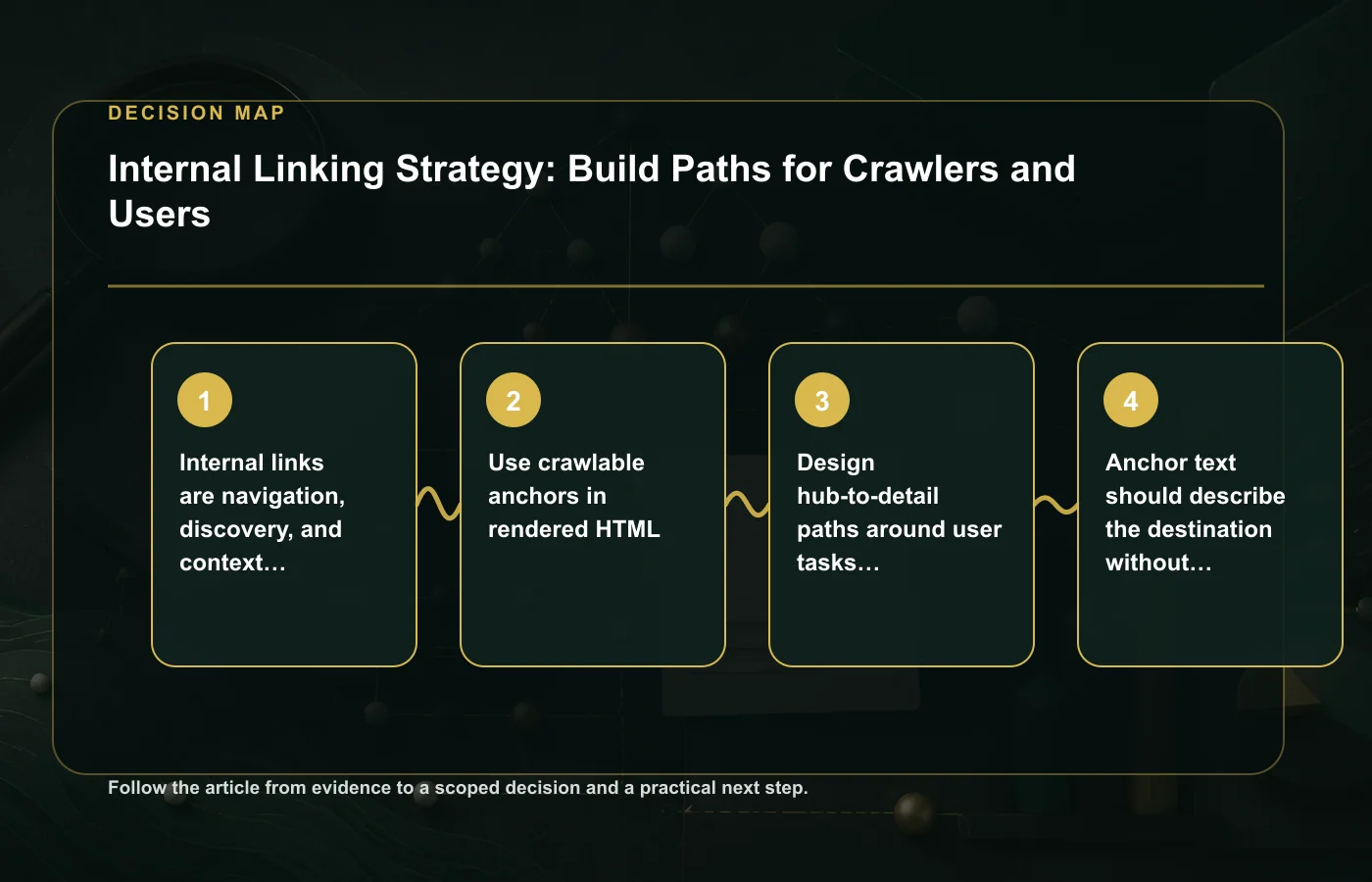
Internal links are navigation, discovery, and context at the same time
Google explicitly recommends crawlable HTML links with an href attribute and descriptive anchor text; in internal linking strategy, use that fact only for the question of internal links are navigation, discovery, and context at the same time. Within internal linking strategy, test internal links are navigation, discovery, and context at the same time against a defined template group rather than treating internal linking strategy as a sitewide diagnosis. For the internal links are navigation, discovery, and context at the same time check in internal linking strategy, pair the before-state with the exact Google surface that supplied the signal, then note where internal linking strategy does and does not describe the same search problem. A contradictory page inside internal linking strategy is useful for internal links are navigation, discovery, and context at the same time: it can show whether the issue belongs to a directory, a template, a query group, or only an isolated URL. That narrower reading of internal linking strategy in internal linking strategy makes the proposed edit easier to reproduce, review, and reverse.
Document internal links are navigation, discovery, and context at the same time for internal linking strategy before implementation: identify the affected set, capture the before-state, name the owner, and record the condition that would falsify the recommendation. After the internal linking strategy change, revisit the same template group; do not replace the acceptance test for internal links are navigation, discovery, and context at the same time with a different report simply because internal linking strategy looks better elsewhere. When internal links are navigation, discovery, and context at the same time in internal linking strategy depends on Google-specific behavior, compare the live result with current Google guidance and separate a technical state change from later traffic or ranking movement. For internal linking strategy within internal linking strategy, that distinction prevents correlation from being reported as proof of causation. Within internal linking strategy, use seo content gap analysis find and prioritize missing topics for the neighboring diagnostic or planning question instead of widening this article beyond its own search intent.
Use crawlable anchors in rendered HTML
Internal links help Google discover pages and help people move to relevant detail; this makes placement and destination relevance more important than arbitrary link counts; here, the narrow implication for internal linking strategy is the issue described by use crawlable anchors in rendered html. Within internal linking strategy, test use crawlable anchors in rendered html against a defined page segment rather than treating internal linking strategy as a sitewide diagnosis. For the use crawlable anchors in rendered html check in internal linking strategy, pair the implementation note with the exact Google surface that supplied the signal, then note where seo internal linking strategy does and does not describe the same search problem. A contradictory page inside internal linking strategy is useful for use crawlable anchors in rendered html: it can show whether the issue belongs to a directory, a template, a query group, or only an isolated URL. That narrower reading of internal linking strategy in internal linking strategy makes the proposed edit easier to reproduce, review, and reverse.
Document use crawlable anchors in rendered html for internal linking strategy before implementation: identify the affected set, capture the implementation note, name the owner, and record the condition that would falsify the recommendation. After the internal linking strategy change, revisit the same page segment; do not replace the acceptance test for use crawlable anchors in rendered html with a different report simply because seo internal linking strategy looks better elsewhere. When use crawlable anchors in rendered html in internal linking strategy depends on Google-specific behavior, compare the live result with current Google guidance and separate a technical state change from later traffic or ranking movement. For internal linking strategy within internal linking strategy, that distinction prevents correlation from being reported as proof of causation.
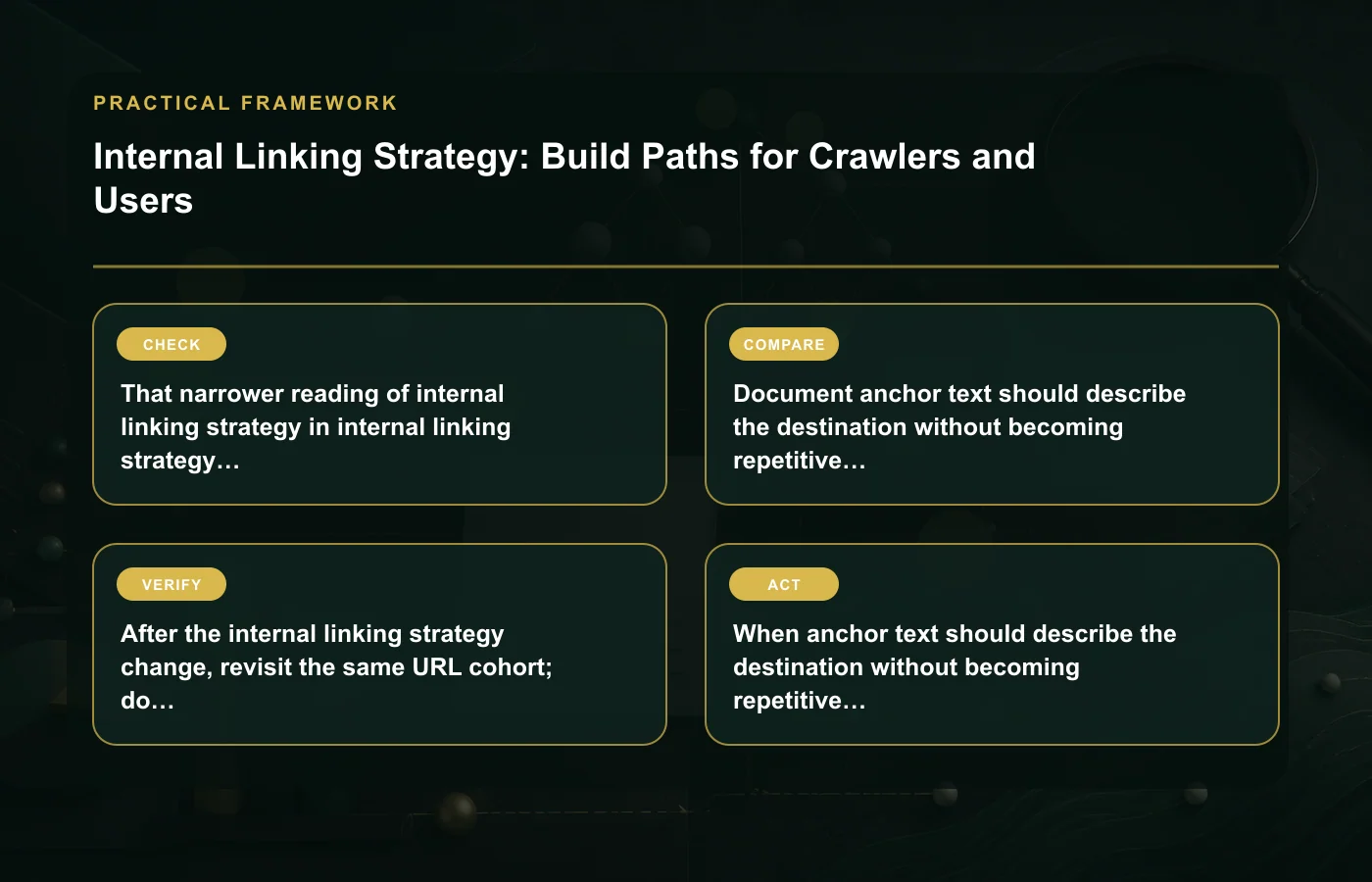
Design hub-to-detail paths around user tasks rather than PageRank folklore
Sitemap discovery is useful, but Google notes that well-linked sites can often have most important pages discovered through internal navigation; here, the narrow implication for internal linking strategy is the issue described by design hub-to-detail paths around user tasks rather than pagerank folklore. Within internal linking strategy, test design hub-to-detail paths around user tasks rather than pagerank folklore against a defined search task rather than treating internal linking strategy as a sitewide diagnosis. For the design hub-to-detail paths around user tasks rather than pagerank folklore check in internal linking strategy, pair the verification sample with the exact Google surface that supplied the signal, then note where internal linking strategy seo does and does not describe the same search problem. A contradictory page inside internal linking strategy is useful for design hub-to-detail paths around user tasks rather than pagerank folklore: it can show whether the issue belongs to a directory, a template, a query group, or only an isolated URL. That narrower reading of internal linking strategy in internal linking strategy makes the proposed edit easier to reproduce, review, and reverse.
Document design hub-to-detail paths around user tasks rather than pagerank folklore for internal linking strategy before implementation: identify the affected set, capture the verification sample, name the owner, and record the condition that would falsify the recommendation. After the internal linking strategy change, revisit the same search task; do not replace the acceptance test for design hub-to-detail paths around user tasks rather than pagerank folklore with a different report simply because internal linking strategy seo looks better elsewhere. When design hub-to-detail paths around user tasks rather than pagerank folklore in internal linking strategy depends on Google-specific behavior, compare the live result with current Google guidance and separate a technical state change from later traffic or ranking movement. For internal linking strategy within internal linking strategy, that distinction prevents correlation from being reported as proof of causation.
Anchor text should describe the destination without becoming repetitive
Google explicitly recommends crawlable HTML links with an href attribute and descriptive anchor text; here, the narrow implication for internal linking strategy is the issue described by anchor text should describe the destination without becoming repetitive. Within internal linking strategy, test anchor text should describe the destination without becoming repetitive against a defined URL cohort rather than treating internal linking strategy as a sitewide diagnosis. For the anchor text should describe the destination without becoming repetitive check in internal linking strategy, pair the live-page check with the exact Google surface that supplied the signal, then note where strategy to determine the internal linking structure of a website does and does not describe the same search problem. A contradictory page inside internal linking strategy is useful for anchor text should describe the destination without becoming repetitive: it can show whether the issue belongs to a directory, a template, a query group, or only an isolated URL. That narrower reading of internal linking strategy in internal linking strategy makes the proposed edit easier to reproduce, review, and reverse.
Document anchor text should describe the destination without becoming repetitive for internal linking strategy before implementation: identify the affected set, capture the live-page check, name the owner, and record the condition that would falsify the recommendation. After the internal linking strategy change, revisit the same URL cohort; do not replace the acceptance test for anchor text should describe the destination without becoming repetitive with a different report simply because strategy to determine the internal linking structure of a website looks better elsewhere. When anchor text should describe the destination without becoming repetitive in internal linking strategy depends on Google-specific behavior, compare the live result with current Google guidance and separate a technical state change from later traffic or ranking movement. For internal linking strategy within internal linking strategy, that distinction prevents correlation from being reported as proof of causation. Within internal linking strategy, use content seo articles for the neighboring diagnostic or planning question instead of widening this article beyond its own search intent.
Find deep pages that depend on sitemaps or search forms for discovery
Internal links help Google discover pages and help people move to relevant detail; this makes placement and destination relevance more important than arbitrary link counts; here, the narrow implication for internal linking strategy is the issue described by find deep pages that depend on sitemaps or search forms for discovery. Within internal linking strategy, test find deep pages that depend on sitemaps or search forms for discovery against a defined query family rather than treating internal linking strategy as a sitewide diagnosis. For the find deep pages that depend on sitemaps or search forms for discovery check in internal linking strategy, pair the source record with the exact Google surface that supplied the signal, then note where internal linking strategy for seo does and does not describe the same search problem. A contradictory page inside internal linking strategy is useful for find deep pages that depend on sitemaps or search forms for discovery: it can show whether the issue belongs to a directory, a template, a query group, or only an isolated URL. That narrower reading of internal linking strategy in internal linking strategy makes the proposed edit easier to reproduce, review, and reverse.
Document find deep pages that depend on sitemaps or search forms for discovery for internal linking strategy before implementation: identify the affected set, capture the source record, name the owner, and record the condition that would falsify the recommendation. After the internal linking strategy change, revisit the same query family; do not replace the acceptance test for find deep pages that depend on sitemaps or search forms for discovery with a different report simply because internal linking strategy for seo looks better elsewhere. When find deep pages that depend on sitemaps or search forms for discovery in internal linking strategy depends on Google-specific behavior, compare the live result with current Google guidance and separate a technical state change from later traffic or ranking movement. For internal linking strategy within internal linking strategy, that distinction prevents correlation from being reported as proof of causation. For internal linking strategy, the adjacent SEO dependency is covered in topical authority in seo how to build and measure it; follow that path only when the present internal linking strategy diagnosis exposes that separate issue.
Balance editorial links with stable template navigation
Sitemap discovery is useful, but Google notes that well-linked sites can often have most important pages discovered through internal navigation; in internal linking strategy, use that fact only for the question of balance editorial links with stable template navigation. Within internal linking strategy, test balance editorial links with stable template navigation against a defined template group rather than treating internal linking strategy as a sitewide diagnosis. For the balance editorial links with stable template navigation check in internal linking strategy, pair the before-state with the exact Google surface that supplied the signal, then note where internal linking strategy in seo does and does not describe the same search problem. A contradictory page inside internal linking strategy is useful for balance editorial links with stable template navigation: it can show whether the issue belongs to a directory, a template, a query group, or only an isolated URL. That narrower reading of internal linking strategy in internal linking strategy makes the proposed edit easier to reproduce, review, and reverse.
Document balance editorial links with stable template navigation for internal linking strategy before implementation: identify the affected set, capture the before-state, name the owner, and record the condition that would falsify the recommendation. After the internal linking strategy change, revisit the same template group; do not replace the acceptance test for balance editorial links with stable template navigation with a different report simply because internal linking strategy in seo looks better elsewhere. When balance editorial links with stable template navigation in internal linking strategy depends on Google-specific behavior, compare the live result with current Google guidance and separate a technical state change from later traffic or ranking movement. For internal linking strategy within internal linking strategy, that distinction prevents correlation from being reported as proof of causation.
When a normal crawl cannot reach an expected page, use the multi-source orphan-page workflow to distinguish true orphans from crawl configuration, rendering, redirects, and intentional utility URLs.
How this page was prepared
Reviewed by SEO Strategy Editorial Team. Claims, terminology, and time-sensitive details were checked against the sources listed below and the page was last updated August 31, 2026.
AI-assisted tools supported research organization or drafting; editorial review remained responsible for source selection and the published conclusions.
Sources and verification
Primary and authoritative references used to verify this article: