

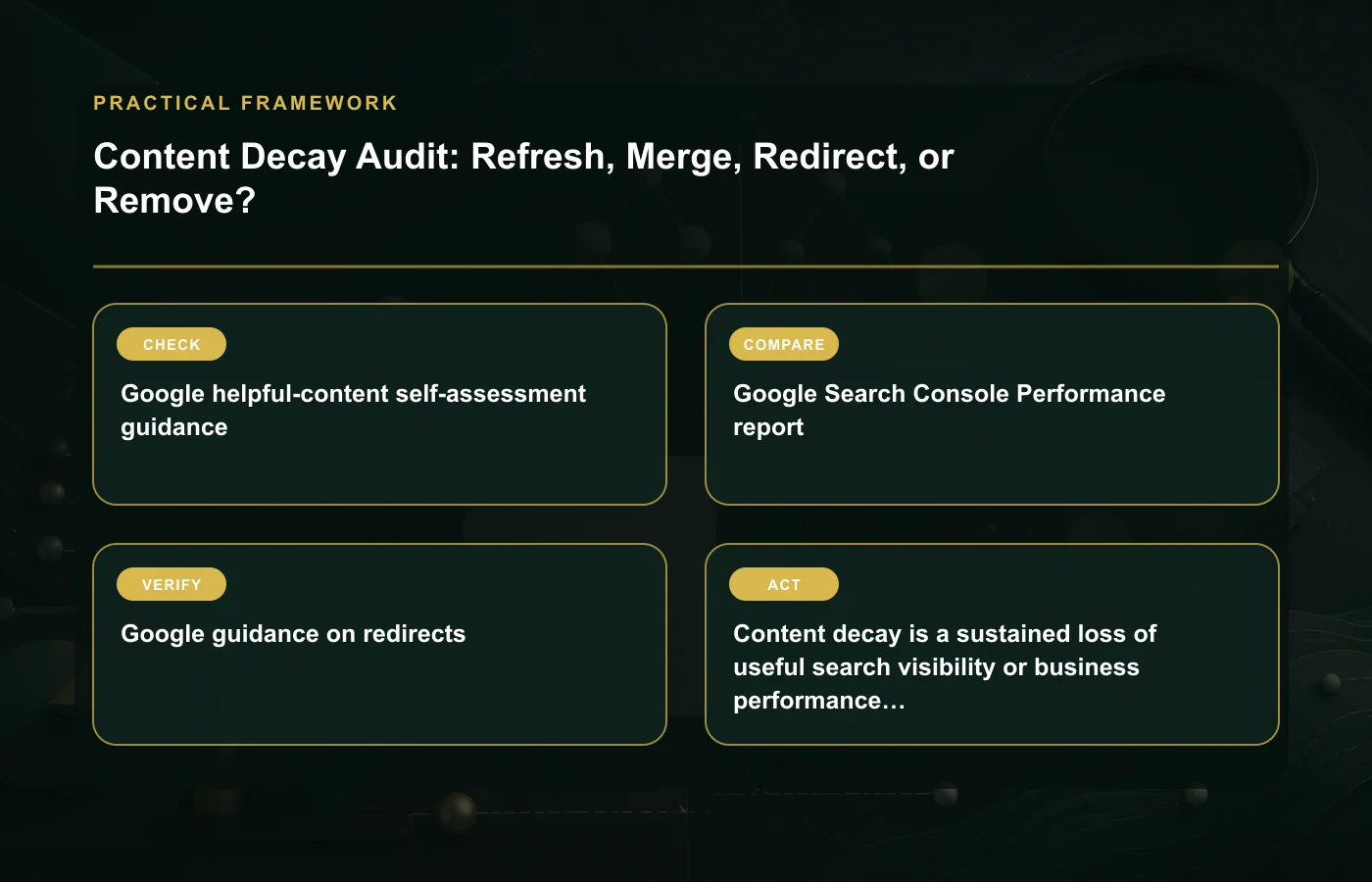
Content decay is a sustained loss of useful search visibility or business performance from an existing page. The cause may be aging facts, changed intent, stronger competing answers, technical changes, internal-link loss, seasonality, or declining demand. A falling traffic line alone does not reveal which.
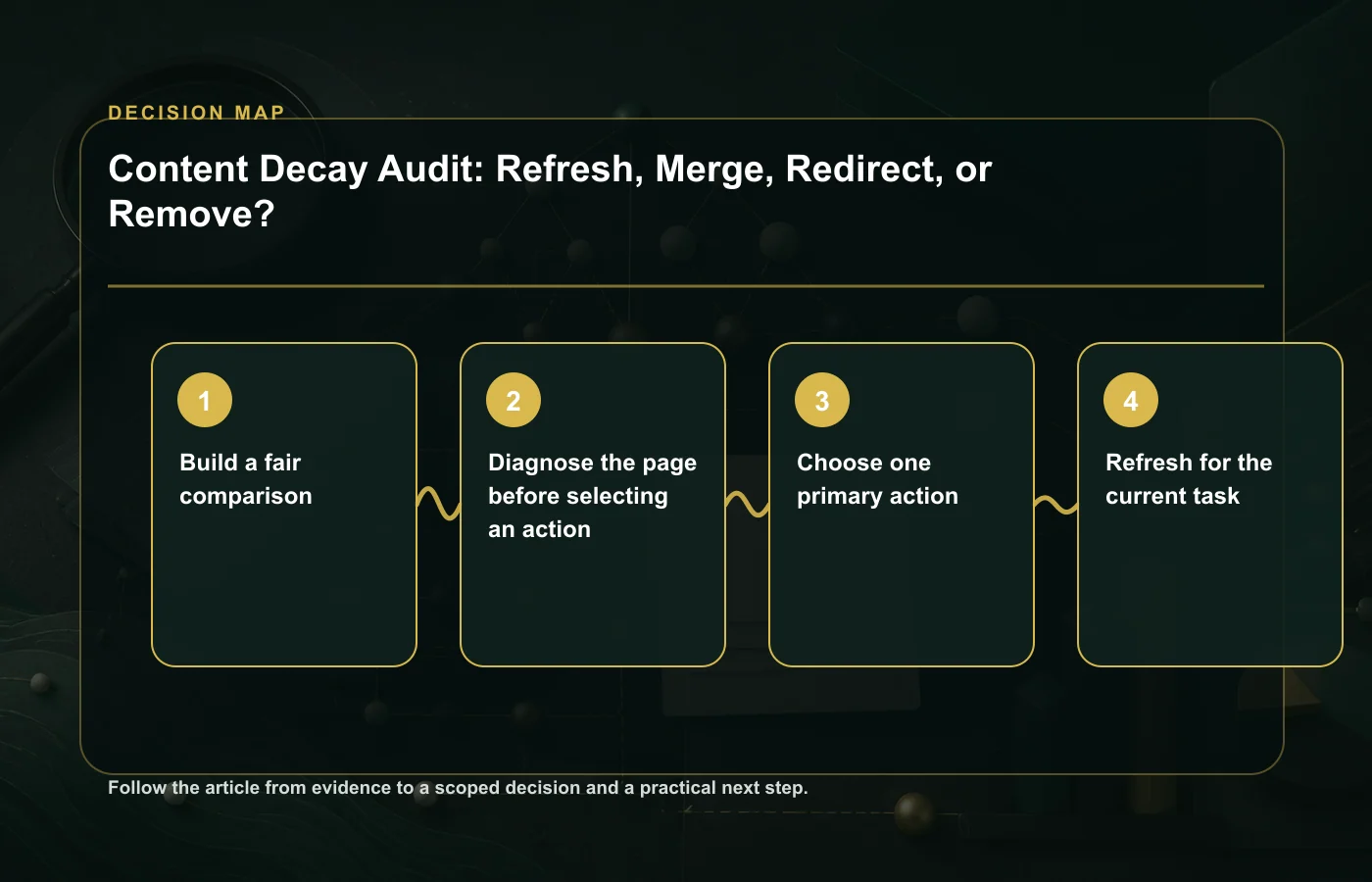
1. Build a fair comparison
Compare equivalent date ranges and segment by page, query group, country, device, and search appearance. Annotate site migrations, releases, campaigns, tracking changes, outages, and known seasonality. Review at least impressions, clicks, click-through rate, average position, qualified sessions, and the page's intended outcome.
| Observed pattern | Likely questions |
|---|---|
| Impressions and demand both decline | Is the topic seasonal, obsolete, or expressed differently? |
| Impressions stable, clicks decline | Did result presentation or the page promise become less competitive? |
| Position declines for the same intent | Is the page stale, less complete, or internally weakened? |
| Traffic stable, conversions decline | Did offer, audience, tracking, or page experience change? |
| Several URLs rotate for one cluster | Do the pages overlap enough to merge or clarify? |
2. Diagnose the page before selecting an action
- Confirm the preferred URL is indexable, canonical, linked, and returning `200`.
- Compare current queries with the page's title, opening promise, and structure.
- Check facts, screenshots, prices, regulations, product states, and cited sources.
- Review competing result types and identify what changed, not merely what is longer.
- Trace internal links lost through redesigns, pruning, or navigation changes.
- Evaluate whether the page still supports a real business and user purpose.
3. Choose one primary action
| Action | Use when | Implementation |
|---|---|---|
| Keep | The page remains accurate and useful; variation is normal | Record the decision and monitor |
| Refresh | The same intent remains, but evidence or clarity is stale | Update substance, sources, examples, and internal links |
| Merge | Several pages weakly serve the same job | Build the strongest combined answer and redirect true predecessors |
| Reposition | The page should serve a distinct intent or audience | Rewrite its promise and linking context |
| Remove | No useful purpose or relevant replacement remains | Return `404` or `410`, and remove internal links and sitemap entries |
4. Refresh for the current task
Preserve useful history and links while improving the page's ability to solve the current problem. Replace obsolete facts, add primary evidence, clarify assumptions, answer newly important questions, repair examples, and improve navigation to related pages. Remove sections that exist only to repeat keywords.
When merging, choose the URL that best represents the intended long-term destination. Evaluate links, current performance, URL clarity, and business ownership. Redirect old URLs directly to the combined page only when it genuinely satisfies the old purpose.
5. Verify after release
Check status, canonical, indexability, internal links, sitemap membership, rendered content, analytics, and Search Console annotations. Early signals may appear at different speeds, so define a review window before declaring success or failure.
Record the hypothesis and result. Over time, this turns content maintenance into a learning system and improves the prioritization model in your SEO roadmap.
Primary references
- Google helpful-content self-assessment guidance
- Google Search Console Performance report
- Google guidance on redirects
How this page was prepared
Reviewed by SEO Strategy Editorial Team. Claims, terminology, and time-sensitive details were checked against the sources listed below and the page was last updated August 6, 2026.
AI-assisted tools supported research organization or drafting; editorial review remained responsible for source selection and the published conclusions.
Sources and verification
Primary and authoritative references used to verify this article:
Download "Content Audit Template" and adapt it to your project.