

An SEO roadmap turns an SEO strategy into a sequence of decisions: where organic search can help the business, what currently prevents that outcome, and which work should happen first. A roadmap for SEO is not a list containing every possible technical fix, keyword, and link tactic — it is the ordered, dated plan a team actually executes.
This distinction matters because a site can complete hundreds of SEO tasks without improving qualified demand. A useful SEO strategy plan connects business outcomes to search behavior, pages, technical access, authority, and measurement, then turns those decisions into a roadmap of SEO work with owners and dates. Below is a sample SEO strategy you can adapt — the same roadmap SEO teams use to move from goals to results: define the outcome, gather evidence, map demand, prioritize, then ship a 90-day plan.
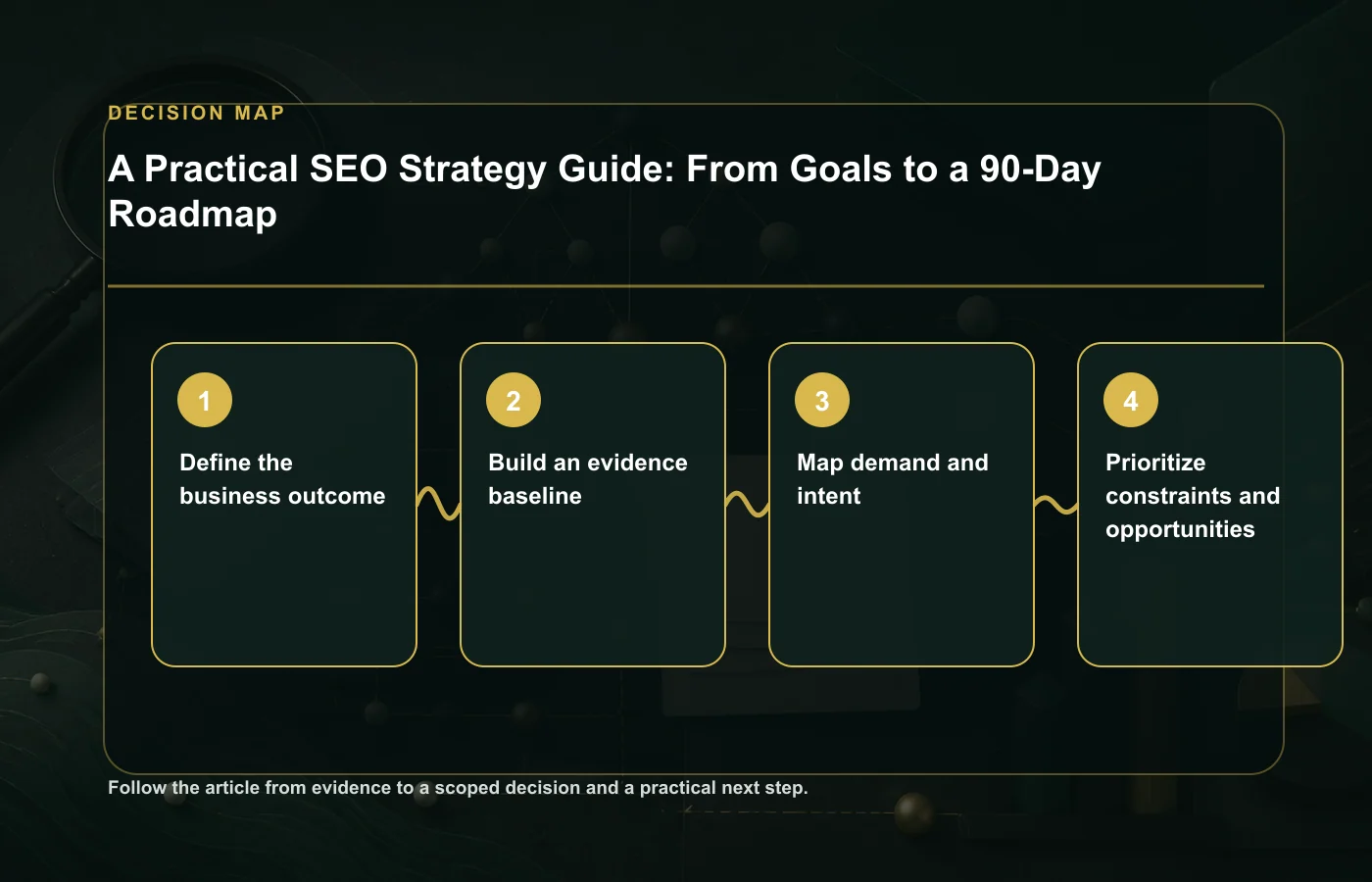
1. Define the business outcome
Start with the action the business needs more people to take. Examples include requesting a quote, starting a trial, visiting a store, comparing products, or learning enough to trust a complex service. Translate that outcome into a small set of observable organic-search behaviors.
| Business question | Search evidence | Useful SEO objective |
|---|---|---|
| Can new buyers discover us? | Non-brand impressions and qualified landing-page visits | Increase relevant category coverage |
| Do visitors understand the offer? | Engaged visits, assisted conversions, repeated objections | Improve decision-stage pages |
| Can search engines access the right pages? | Indexing reports, crawl samples, canonical signals | Remove technical discovery constraints |
| Does the market trust our claims? | Relevant citations, branded searches, qualified referrals | Publish and promote source-worthy evidence |
2. Build an evidence baseline
Before researching new keywords, establish what the site already has. Export at least 12 to 16 months of Google Search Console data when available so that seasonality is less likely to distort the diagnosis. Segment brand and non-brand queries, device type, country, page group, and search appearance where the sample is large enough.
Pair performance data with a technical sample. The goal is not to produce the largest crawl possible. The goal is to understand templates and failure patterns:
- Which indexable templates exist, and which should not be indexed?
- Do canonical tags, redirects, internal links, and sitemaps agree?
- Are important pages reachable through ordinary HTML links?
- Which page groups earn impressions but few clicks?
- Which pages attract qualified visits but fail to support the next action?
- Where do multiple pages compete for the same intent?
Use the technical SEO audit checklist to turn these observations into reproducible checks.
3. Map demand and intent
Build a demand map from customer language, Search Console queries, sales conversations, internal site search, competitor coverage, and relevant search results. Search volume can help with scale, but it cannot decide whether a query matters to the business.
Group queries when the same page can satisfy the same underlying job. Separate them when a searcher needs a different page type, depth, comparison, location, or next action. A product category, a troubleshooting guide, and a local service page may share vocabulary while serving three different intents.
For each cluster, record:
- Primary searcher problem and stage of awareness
- Expected page type and the evidence needed to be credible
- Existing URL, proposed URL, or decision not to create a page
- Business value, demand confidence, effort, and dependency
- Internal pages that should link to and from the result
Our keyword mapping guide provides a complete worksheet structure.
4. Prioritize constraints and opportunities
Score opportunities with a simple model instead of an opaque formula. A practical review uses four factors: expected impact, confidence in the evidence, implementation effort, and strategic reach. Strategic reach asks how many future pages benefit from the work. Fixing a shared canonical bug may improve thousands of URLs; rewriting one low-demand article improves one.
| Priority | Typical work | Why it belongs here |
|---|---|---|
| Now | Indexing blockers, broken revenue pages, severe intent mismatch | Current demand cannot reach or use the right page |
| Next | High-value content gaps, internal linking, template improvements | Evidence is strong and dependencies are clear |
| Later | Low-confidence topics, minor metadata cleanup, speculative tools | Impact is limited or another change must happen first |
| Do not do | Doorway pages, scaled near-duplicates, purchased link volume | Creates risk without durable user value |
5. Create your 90-day roadmap
Creating an SEO roadmap means turning the prioritized backlog into a plan that is small enough to manage and specific enough to verify. Organize it by outcomes, not departments — technical, editorial, design, analytics, and outreach work often support the same result. The table below is a sample SEO roadmap example: adapt the windows and focus areas to your own backlog rather than copying the tasks verbatim.
| Window | Focus | Exit evidence |
|---|---|---|
| Days 1-30 | Baseline, template inventory, measurement, urgent access issues | Trusted data and a ranked constraint list |
| Days 31-60 | Primary page improvements, content briefs, internal paths | Priority pages published or materially improved |
| Days 61-90 | Supporting coverage, promotion, quality review, next-cycle learning | Early query, crawl, engagement, and conversion signals |
Each roadmap item needs an owner, target page group, rationale, acceptance criteria, dependencies, and review date. When a task lacks those fields, it is usually an idea rather than committed work.
6. Measure decisions, not vanity
Rankings and traffic are useful diagnostics, but neither proves business impact alone. Review leading and lagging indicators together:
- Discovery: indexable pages, impressions, query coverage, and crawl behavior.
- Relevance: qualified clicks, landing-page engagement, and movement for intended query groups.
- Outcomes: leads, sales, trials, store actions, or assisted conversions from organic entry pages.
- Durability: content decay, returning demand, relevant citations, and performance after major site changes.
Compare equivalent periods and annotate migrations, releases, campaigns, tracking changes, and seasonality. A chart without operational context can describe what happened while still leading to the wrong decision.
What a finished strategy should contain
- A one-page statement of audience, business outcome, constraints, and focus
- A demand and keyword-to-page map
- A prioritized technical and content backlog
- A 90-day roadmap with owners and acceptance criteria
- A measurement plan with segments, baselines, and review dates
- A decision log explaining what changed and why
SEO strategy execution: from plan to results
A strategy only produces results once it is executed on schedule. Run the 90-day roadmap in its three windows, review the exit evidence at each stage, and update the backlog instead of restarting it. Teams that treat the roadmap as a living document — revisiting priorities as new evidence arrives — get more consistent results than teams that write a plan once and file it away.
SEO roadmap FAQ
What does an SEO roadmap example look like?
A usable example is the 90-day table above: three windows (days 1-30, 31-60, 61-90), a focus for each, and the exit evidence that proves the window worked. The best SEO roadmap examples also add an owner, target page group, rationale, acceptance criteria, dependencies, and a review date to every item — without those fields, a roadmap is a wish list rather than committed work.
How do you create an SEO roadmap?
This follows the same six steps this guide walks through: define the business outcome, build an evidence baseline, map demand and intent, prioritize the backlog, lay out the 90-day roadmap, then measure decisions instead of vanity metrics. Teams that skip straight to the roadmap step usually end up prioritizing tasks that no evidence supports.
What is a 90-day SEO sprint?
A 90-day SEO sprint is this roadmap's planning horizon: one 90-day cycle, reviewed monthly, split into the three windows above. It gives a team enough time to gather evidence, ship priority pages, and see early query and conversion signals — then start the next cycle. Effective SEO roadmaps treat each 90-day sprint as one iteration in an ongoing plan, not a one-time document; some teams label the finished output an SEO master plan, an SEO strategy outline, or SEO strategy planning, but the structure in this guide works under any of those names.
For an audience-specific application of this planning model, see SEO for consulting firms.
When the strategic choices are ready to record, use the guide to building an SEO strategy document with objectives, evidence, workstreams, owners, roadmap, KPIs, risks, and review cadence.
If you are still building the skills needed to execute this strategy, follow the SEO learning roadmap from search fundamentals and measurement through technical, content, authority, and operating work.
For the planning layer above a 90-day roadmap, use the 12-month SEO plan to define annual outcomes, quarterly priorities, dependencies, capacity, KPIs, and review gates.
Primary references
- Google SEO Starter Guide
- Google guidance for helpful, reliable, people-first content
- Google Search Console Performance report documentation
How this page was prepared
Reviewed by SEO Strategy Editorial Team. Claims, terminology, and time-sensitive details were checked against the sources listed below and the page was last updated August 6, 2026.
AI-assisted tools supported research organization or drafting; editorial review remained responsible for source selection and the published conclusions.
Sources and verification
Primary and authoritative references used to verify this article: