

An SEO strategy document is the decision record that explains what the organization wants organic search to achieve, what the current constraints and opportunities are, which technical, content, and authority workstreams deserve priority, who owns them, how they will be sequenced, and how progress will be measured. It should be specific enough to guide execution without becoming a backlog of every possible SEO tactic.
A useful document connects evidence to choices. It explains why one market, page group, content cluster, or technical constraint matters more than another; what the team will deliberately not prioritize; which assumptions still need validation; and what success will look like. The roadmap, briefs, tickets, and reporting system can then be built from those decisions.
If you need an editable file, use the existing SEO Strategy Template. This guide explains what belongs in the document and how the sections should work together.
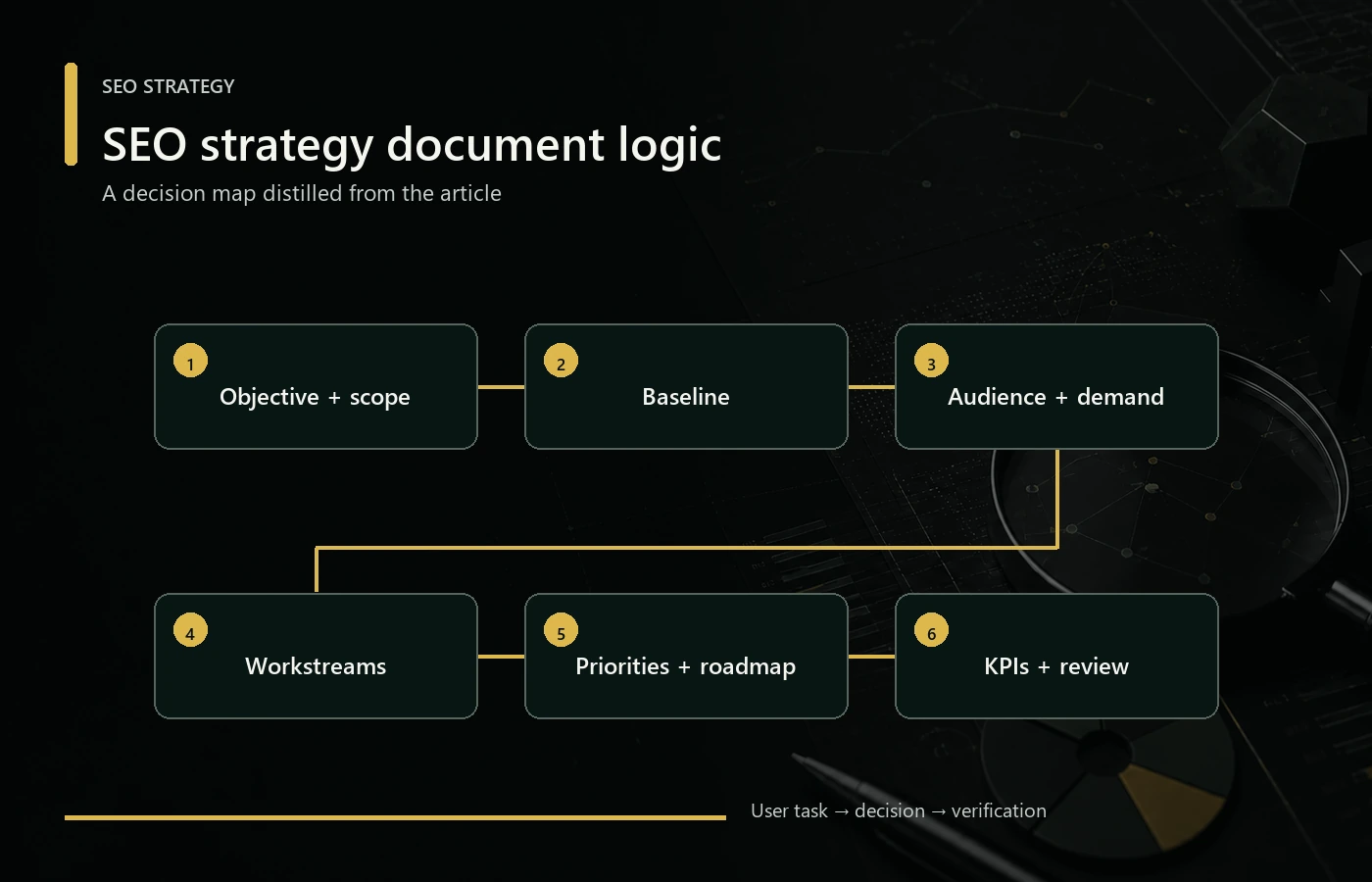
What an SEO strategy document should do
The document has three jobs:
- Make the direction explicit. Stakeholders should understand the business objective, target audiences, search opportunity, constraints, and strategic choices.
- Turn analysis into priorities. The document should explain which technical, content, architecture, and authority initiatives come first and why.
- Create an operating reference. Owners, dependencies, roadmap logic, KPIs, risks, and review cadence should be clear enough that the strategy can guide future decisions without being rewritten every week.
It is not the same as an SEO audit, keyword map, content calendar, or task backlog. Those can be inputs or execution artifacts. The strategy document sits above them and records the choices that connect them.
Strategy document vs. plan, roadmap, audit, and presentation
| Artifact | Main purpose | Typical level of detail |
|---|---|---|
| SEO audit | Diagnose current issues and evidence | Findings, scope, severity, recommendations, validation |
| SEO strategy document | Choose the direction and priorities | Objectives, baseline, audience, workstreams, priorities, resources, KPIs, risks |
| SEO roadmap | Sequence execution | Initiatives, dependencies, owners, phases, milestones |
| SEO plan / backlog | Manage operational work | Tasks, briefs, tickets, dates, statuses |
| SEO presentation | Communicate the strategy to stakeholders | Condensed decisions, evidence, priorities, resourcing, roadmap |
The parent SEO Strategy Guide covers the broader strategy-building process. This page focuses specifically on the document that records the result.
1. Start with objectives and constraints
Open with the business problem, not with a list of SEO activities. The objective should be something organic search can plausibly influence and the organization can measure.
Examples of useful objective statements:
- Increase qualified non-brand discovery for the company’s priority services in two defined markets.
- Reduce reliance on paid acquisition for a group of repeatable high-intent product searches.
- Improve organic visibility for a new category architecture while preserving existing high-value traffic during migration.
- Build an expert content system that supports a long B2B buying cycle and contributes to qualified pipeline.
Avoid objectives such as “rank number one,” “increase domain authority,” or “publish 100 articles.” Those may describe a desired search outcome, a third-party metric, or an output, but they do not define the business value the strategy is meant to create.
Record the constraints immediately
Constraints shape the strategy as much as opportunities do. Capture them before recommending work:
- engineering capacity and release cycles;
- CMS or platform limitations;
- content-review and subject-matter expertise capacity;
- markets, products, or services the business can actually support;
- legal, regulatory, brand, or accessibility requirements;
- available analytics and CRM data;
- existing migrations, redesigns, or product launches;
- authority or reputation limitations in the target topic;
- budget and dependency on agencies, vendors, or other teams.
A strategy that ignores known constraints is a wish list.
2. Establish the baseline
The baseline should explain the current state in enough detail to justify priorities. It does not need every SEO metric available.
Useful baseline inputs include:
- organic clicks, impressions, and query/page patterns in Search Console;
- organic landing-page conversions or qualified lead/revenue signals where available;
- current indexed page groups and known indexation problems;
- site architecture and major template types;
- current commercial and informational page inventory;
- existing authority signals and link profile at the level needed for the decision;
- major recent changes such as migrations, redesigns, domain changes, or content pruning;
- known measurement gaps.
Google Search Console’s Performance report provides clicks, impressions, CTR, average position, and dimensions such as queries, pages, countries, and devices. Use those metrics to understand current search behavior, but avoid treating a single average position value as the business baseline. Query data is also incomplete, so combine Search Console with analytics, CRM, crawl data, and the site inventory.
Baseline summary example
Illustrative only: “The site receives most non-brand organic clicks from informational pages, while the three highest-margin service groups have limited non-brand visibility. Search Console shows service-related impressions distributed across several general pages rather than dedicated service URLs. The site has a workable technical foundation, but internal linking from informational content to service pages is inconsistent. Engineering capacity is limited for the next quarter, so the first strategy phase will prioritize page ownership, commercial content, and internal linking before large technical projects that are not currently blocking indexation.”
This paragraph is more useful than a dashboard screenshot because it states the decision implications.
3. Define the audience and search demand
SEO strategy should describe who the site needs to reach and how those people search at different stages of a decision.
For each priority audience, record:
- role or buyer type;
- problem or job to be done;
- service, product, or information need;
- geographic or language context;
- commercial stage;
- important search themes;
- evidence source for the demand;
- current page responsible for the intent, if one exists.
Do not turn this into a fictional persona exercise unless the business actually uses validated personas. A concise audience-demand map is usually more actionable.
| Audience | Search task | Intent | Current coverage | Strategy implication |
|---|---|---|---|---|
| Operations leader | Compare solutions for a defined operational problem | Commercial investigation | Generic service page | Create or strengthen a solution page if the evaluation criteria are distinct |
| Technical evaluator | Understand implementation requirements | Informational | Several fragmented articles | Consolidate into one authoritative guide and link to the commercial destination |
| Existing customer | Find documentation or support | Navigational / support | Help center | Keep outside the acquisition content backlog unless search visibility is part of the support goal |
4. Summarize the competitive landscape by search problem
A competitor section should not be a list of domains with “DA” scores. It should explain what the site is competing against for the target search tasks and where the difference is structural, editorial, commercial, or authority-related.
Review:
- which page types dominate the most important query groups;
- how competitors separate services, industries, products, templates, and informational content;
- where competitors provide stronger proof, tooling, data, or expert depth;
- which topics are crowded with strong incumbents and may require a different angle or more authority;
- where the business has a genuine advantage that is not yet represented on the site;
- where search demand is weak or irrelevant despite competitor coverage.
The goal is to understand the standard a page must meet and the strategic gaps that matter. Do not copy competitor information architecture simply because it ranks.
5. Define the technical SEO workstream
The technical workstream should include only the technical conditions that materially affect the strategy. A full audit can sit in a separate document.
Typical strategic questions:
- Can priority page groups be discovered, crawled, rendered, and indexed as intended?
- Are canonical, redirect, sitemap, and internal-link signals consistent?
- Does the architecture support the intended commercial and content hierarchy?
- Are JavaScript, faceted navigation, pagination, or parameter rules creating search problems?
- Are migrations or platform changes likely to alter URL ownership or indexation?
- Does page performance create a material usability or search constraint on important templates?
State the strategic consequence, not every technical finding. For example: “Category canonical inconsistencies must be resolved before expanding category content because the preferred-URL state is unstable.”
6. Define the content and page-architecture workstream
The content workstream should specify which kinds of pages need to be created, improved, consolidated, or connected.
Include:
- primary commercial page groups;
- pillar and supporting informational pages where justified;
- templates, tools, or downloadable assets that serve separate intents;
- content gaps that pass a relevance and evidence test;
- existing pages that should be updated rather than replaced;
- cannibalization and consolidation decisions;
- internal-link relationships between informational and commercial content;
- editorial evidence and review standards.
A strategy should not promise a fixed article count unless there is a validated reason for that number. Google’s people-first content guidance explicitly warns against producing content primarily for search traffic or writing to a preferred word count. The document should prioritize complete useful pages, not production volume.
7. Define the authority workstream
“Build backlinks” is not a strategy. Explain what kind of authority the site lacks and what credible mechanisms can improve it.
Depending on the business, this can include:
- digital PR around original research or real company expertise;
- expert contributions and partnerships;
- useful tools, datasets, templates, or reference resources that earn citations;
- improving discoverability of existing assets that already deserve links;
- reclaiming broken or outdated references;
- closing authority gaps around priority commercial page groups.
Keep tactics within search-engine spam policies and the organization’s editorial standards. Paid or supplied relationships should be handled transparently and with appropriate link attributes where required.
8. Prioritize the workstreams
Prioritization is the section that turns research into strategy. Use a small set of decision factors that stakeholders can understand.
| Factor | Question |
|---|---|
| Business relevance | Does this support a priority product, service, market, or strategic objective? |
| Search opportunity | Is there credible demand or existing visibility to improve? |
| Constraint removal | Does this unblock other work or fix a condition limiting important pages? |
| Evidence strength | How confident are we that the problem and proposed action are real? |
| Reach | How many important pages, users, or journeys are affected? |
| Effort | What research, content, engineering, design, or legal work is required? |
| Dependency | What must happen before or after this initiative? |
| Reversibility / risk | How difficult is it to reverse the change if the assumption is wrong? |
A weighted score can help compare many initiatives, but the document should still explain the strategic reasoning in plain language. Do not hide a judgment behind a spreadsheet score.
9. Specify resources and ownership
For every strategic workstream, identify the accountable owner and the capabilities needed to execute it.
| Workstream | Accountable owner | Supporting roles | Typical dependency |
|---|---|---|---|
| Technical SEO | Technical SEO / product owner | Engineering, analytics, QA | Release cycle and test environment |
| Commercial pages | SEO / marketing lead | Product or service owner, content, legal | Approved positioning and proof |
| Expert content | Editorial lead | SEO, subject-matter experts, fact-checker | Reviewer capacity and evidence |
| Authority | PR / link acquisition owner | Experts, data, design, partnerships | Assets worth promoting |
| Measurement | Analytics owner | SEO, CRM, sales / ecommerce | Consistent event and source data |
Resource gaps are part of the strategy. If the company cannot currently support expert review, the correct decision may be to reduce publishing scope rather than pretending the dependency does not exist.
10. Build the roadmap from dependencies
The strategy document should show sequencing, but it does not need to become the project-management system.
A practical roadmap can use phases:
- Phase 1 — Stabilize: fix blocking technical conditions, measurement gaps, and page-ownership conflicts.
- Phase 2 — Strengthen core pages: improve priority commercial pages, architecture, and internal linking.
- Phase 3 — Expand validated coverage: create missing informational, commercial, template, or tool pages with distinct intents.
- Phase 4 — Build authority and compound gains: promote assets, deepen topic coverage where evidence supports it, and improve weaker page groups.
For a more detailed operating sequence, the strategy can link to a dedicated roadmap or project tracker. Dates should be added only when owners and effort are known.
11. Choose KPIs that match the objective
KPIs should connect the workstream to the business objective. Use leading indicators for diagnosis and lagging indicators for outcomes.
| Layer | Examples | Use |
|---|---|---|
| Implementation | Priority templates fixed, pages published, internal links added, approved page ownership resolved | Did the planned work happen? |
| Search visibility | Relevant query impressions, clicks, CTR, indexed target pages, non-brand visibility | Is search exposure changing? |
| Engagement / conversion | Qualified leads, ecommerce transactions, trial starts, meaningful downloads, assisted journeys | Are users completing useful business actions? |
| Business | Qualified pipeline, revenue, customer acquisition contribution, cost efficiency where attribution is credible | Is organic search contributing to the strategic objective? |
Not every strategy can measure all four layers perfectly. Document attribution limits instead of inventing precision.
12. Record risks and assumptions
A strategy document should make uncertainty visible. Include a risk register for the assumptions that could materially change priorities.
| Risk / assumption | Why it matters | Mitigation or test |
|---|---|---|
| Engineering capacity may be lower than planned | Technical fixes could delay content or migration work | Prepare a content/architecture path that does not depend on the blocked release where possible |
| Search demand estimate is based largely on third-party tools | Volume may be overstated or miss long-tail demand | Combine with Search Console, sales questions, site search, and pilot-page performance |
| International market requires more localization than expected | Translation-only rollout may not satisfy users or commercial requirements | Validate demand, service availability, terminology, and legal requirements before scaling |
| Qualified-lead tracking is incomplete | Traffic growth may be mistaken for commercial success | Define CRM fields and source handling before using lead volume as a KPI |
13. Set a review cadence based on decision change
The strategy should not be rebuilt every month. Review it when enough evidence has changed to affect priorities.
A practical cadence:
- Monthly operating review: implementation status, blockers, material search changes, measurement issues.
- Quarterly strategy review: priorities, demand shifts, page ownership, resource changes, major wins/losses, next workstream sequence.
- Event-driven review: migration, redesign, acquisition, product launch, market expansion, major algorithm or platform change, or significant business-model change.
The monthly review should not rewrite the strategy document unless a decision actually changes. Keep a short decision log so stakeholders can see what changed and why.
A practical SEO strategy document outline
- Executive summary
- Objective
- Current situation
- Three to five strategic priorities
- Major constraints
- What success will look like
- Objectives and scope
- Business objectives
- SEO contribution
- In-scope markets, products, services, and page groups
- Explicit exclusions
- Baseline
- Search performance
- Conversion/business baseline
- Technical and architectural state
- Content inventory
- Measurement limitations
- Audience and search demand
- Priority audiences
- Search tasks and intent clusters
- Current URL ownership
- Gaps and overlaps
- Competitive landscape
- Relevant search competitors
- Page-type patterns
- Authority and proof differences
- Distinctive opportunities
- Technical workstream
- Content and architecture workstream
- Authority workstream
- Prioritization framework
- Resources, owners, and dependencies
- Roadmap
- KPIs and measurement
- Risks and assumptions
- Review cadence and decision log
Worked one-page strategy summary example
Illustrative example:
| Field | Example |
|---|---|
| Objective | Increase qualified organic discovery for two priority B2B services without expanding into unrelated high-volume topics. |
| Baseline | Informational pages drive most non-brand visibility; commercial intent is split across generic pages; lead-quality attribution is incomplete. |
| Primary audience | Operations and marketing leaders evaluating specialist support. |
| Key constraint | Limited expert-review capacity and one engineering release per month. |
| Technical priority | Resolve canonical and internal-link inconsistencies on priority commercial templates. |
| Content priority | Strengthen four service pages, consolidate overlapping guides, then publish a small number of expert pages tied to validated buyer questions. |
| Authority priority | Promote two evidence-backed reference assets rather than running broad low-relevance outreach. |
| Measurement | Search Console query/page visibility, qualified leads by landing page, implementation completion, and pipeline stage where attribution is available. |
| First review | After the first implementation phase or sooner if the planned site release changes scope. |
A full strategy document expands the evidence and reasoning behind each row, but the core decisions should still be understandable at this level.
How to keep the document usable
- Put raw exports in appendices or working files, not in the main narrative.
- Link each priority to the evidence that supports it.
- Mark assumptions and unresolved questions visibly.
- Use one accountable owner for each workstream.
- Separate strategy choices from implementation details that belong in tickets.
- Remove tactics that do not change the plan.
- Use consistent names for page groups, markets, and workstreams across the document and roadmap.
- Update the document when a decision changes, not to make the “last updated” date look fresh.
QA the strategy before hand-off
Before the document becomes the working strategy, check:
- Objective: Is the business outcome explicit?
- Scope: Are markets, audiences, and exclusions clear?
- Evidence: Can stakeholders trace major priorities to baseline data or observable constraints?
- Demand: Are search opportunities mapped to page roles rather than just keyword lists?
- Priorities: Does the document explain what comes first and what is deliberately deferred?
- Resources: Are owner and capacity assumptions realistic?
- Roadmap: Does sequencing follow dependencies?
- Measurement: Do KPIs connect implementation, search visibility, and business outcomes where possible?
- Risk: Are the assumptions that could change the plan visible?
- Maintenance: Is there a clear review cadence and decision log?
Use the SEO Strategy Checklist as a separate verification pass. For stakeholder communication, the SEO Strategy Presentation Template is designed to condense the strategy into situation, priorities, resourcing, roadmap, and success metrics without turning the deck into the working document.
The finished SEO strategy document should make future decisions easier. If a new content idea, technical request, or market opportunity appears, the team should be able to compare it against the stated objective, audience, constraints, priorities, and measurement model. If the document cannot help make that decision, it is probably too generic.
How this page was prepared
Reviewed by SEO Strategy Editorial Team. Claims, terminology, and time-sensitive details were checked against the sources listed below and the page was last updated September 3, 2026.
AI-assisted tools supported research organization or drafting; editorial review remained responsible for source selection and the published conclusions.
Download "SEO Strategy Template" and adapt it to your project.