

SEO for consulting firms is a lead-generation system for making the firm's expertise discoverable at the points where prospective clients research a problem, compare approaches, evaluate specialist fit, and shortlist advisers. The goal is not to maximize blog traffic. It is to earn visibility for the commercial and expert pages that help a qualified buyer understand what the firm solves, for whom, in which situations, and why its advice is credible.
That usually means building a clear service architecture, adding industry or use-case pages only where the work genuinely differs, publishing expert content around the questions buyers investigate before contacting a firm, and connecting those pages to evidence such as author profiles and relevant case studies. Measurement should follow the same logic: track search visibility and enquiries, but judge SEO by qualified opportunities, pipeline contribution, and fit — not sessions alone.
Why SEO works differently for consulting firms
Consulting is usually a considered purchase. A buyer may encounter a firm while researching a problem, return later for a specific service, circulate a page internally, compare several advisers, and contact the firm only after budget, timing, and stakeholder alignment are clearer. SEO therefore has to support both discovery and due diligence.
Three characteristics shape the strategy:
- Demand is fragmented. Buyers may search by service name, business problem, industry, regulation, method, location, role, or desired outcome. Internal consulting terminology does not always match the language prospects use.
- The buying cycle is long and non-linear. An informational article can influence a later enquiry without being the final landing page. A service page can be visited several times before a form is submitted.
- Trust carries more weight than raw volume. A consulting firm can attract thousands of low-fit visits and generate little commercial value. A smaller set of searches tied closely to expertise, buyer need, and decision stage can be far more useful.
This is why consulting-firm SEO should be planned as a page system rather than a publishing calendar.
Start with the firm's demand model
Before choosing keywords, map how prospects describe the firm's work. Build the demand model from four perspectives:
| Demand layer | Example search pattern | Likely page type |
|---|---|---|
| Service | “supply chain strategy consulting” | Service page |
| Problem / outcome | “reduce procurement costs consulting” | Service, solution, or expert guide depending on intent |
| Industry | “healthcare operations consulting” | Industry page if the offer and proof materially change by sector |
| Research / evaluation | “how to evaluate pricing strategy” | Expert article, framework, checklist, or example |
| Provider comparison | “pricing strategy consulting firms” | Commercial service or capability page |
| Geographic | “management consulting firm in Manchester” | Local office/location page where a real local presence exists |
Then map every meaningful query cluster to an existing or proposed URL. The same keyword family should not be spread across a generic service page, a nearly identical industry page, and several blog posts without a clear reason. Search Console can help identify which queries already surface which pages, but its query data should be treated as one demand signal rather than a complete market map.
Make service pages the commercial backbone
For most consulting firms, service pages should own the highest-intent searches. A strong service page is not a brochure paragraph surrounded by a contact form. It should help a buyer decide whether the service is relevant before they speak to anyone.
Useful service-page content typically answers:
- What business problem does the service address?
- Which organizations or situations is it designed for?
- What is in scope and what is not?
- How does the engagement usually progress?
- What inputs does the client need to provide?
- What kinds of outputs or decisions does the work support?
- What expertise is relevant to the work?
- What evidence can the firm show without exaggerating or disclosing confidential information?
- Which related services or specialist topics should the buyer understand next?
Service pages should use the terminology prospects recognize while preserving the firm's own positioning. Do not create a separate page for every minor keyword modifier. Create another URL only when the user task, audience, evaluation criteria, or service scope changes enough to justify a distinct answer.
Use industry pages only when the industry changes the work
Industry pages can be effective for consulting firms because buyers often want evidence that an adviser understands their operating environment. They also create a common SEO failure: identical service copy repeated across a list of sectors with the industry name swapped.
An industry page earns its own URL when it can contain genuinely sector-specific information such as:
- different operating constraints or buying criteria;
- sector-specific terminology and workflows;
- regulatory or compliance context that materially changes the engagement;
- different stakeholders or implementation risks;
- relevant case evidence, experience, or expert commentary;
- a service mix that differs from the generic offer.
If the page cannot explain why consulting for that sector is substantively different, strengthen the main service page instead of multiplying thin industry pages.
Publish expert content for the research that happens before contact
Expert content should address the questions qualified buyers investigate before they are ready to shortlist a firm. This content is not a substitute for service pages; it supports them.
High-value formats often include:
- diagnostic guides that help a buyer recognize the problem;
- decision frameworks that compare plausible approaches;
- implementation risks and failure modes;
- benchmarks or data where the firm can publish a defensible methodology;
- worked examples that make a process understandable without inventing client results;
- regulatory or market changes interpreted through the firm's domain expertise;
- checklists and templates that help teams prepare for a project;
- case studies that explain the situation, intervention, constraints, and verified outcome where permission and evidence exist.
A useful test is whether the article would still deserve to exist if search traffic were removed from the equation. Google’s people-first guidance asks publishers to create content for an intended audience, provide substantial value, and make authorship and expertise clear where readers would expect it. Those are particularly relevant controls for advisory content.
Build trust into the information architecture
Consulting buyers evaluate expertise as they read. Trust therefore has to be easy to verify across the site, not hidden on one “About” page.
Authorship
Use accurate bylines where a named expert actually contributed or reviewed the material. Link to profiles that explain relevant experience without inflating credentials. If content is produced by an editorial team, identify the responsible organization rather than inventing individual experts.
Case studies
Case studies are strongest when they document a real situation and a verifiable intervention. Avoid anonymous “client success” stories that contain precise improvements but no way to understand the baseline, timeframe, scope, or evidence. Where confidentiality prevents detailed disclosure, be explicit about what can and cannot be shown.
Methods and evidence
For technical or analytical consulting, explain how conclusions are reached. A methodology page, cited primary sources, named frameworks, or clear assumptions make an argument easier to evaluate. The point is not to disclose proprietary work; it is to let a buyer distinguish expertise from generic copy.
Commercial clarity
Make it clear which pages explain the subject and which pages describe the firm's service. Educational pages should be useful without forcing a sales pitch, while service pages should give enough detail for a prospective client to judge fit.
Connect expert content to commercial pages without turning it into advertising
Internal links should follow the buyer's next logical question. An article about a problem can link to the service that addresses that problem when the reader has enough context to understand the relationship. A service page can link back to deeper explanatory material when a buyer needs evidence or education before making contact.
Use descriptive anchors. “Pricing strategy consulting” is more useful than “click here” when that is the actual destination. At the same time, do not repeat the same exact-match anchor across every page. The anchor should describe the destination naturally in context.
For broader B2B architecture principles, the existing B2B SEO Consulting page describes how services, industries, buyer research, and long consideration cycles fit together. This guide remains focused on what a consulting firm should build and measure itself.
Choose a local, national, or international model deliberately
The right geographic model depends on how the firm sells and delivers work. A consultancy with one city office and a locally concentrated client base has different search needs from a national specialist or an international advisory group.
| Model | SEO priorities | Common mistake |
|---|---|---|
| Local | Real office/location pages, accurate business information, locally relevant services and proof, Google Business Profile where eligible | Creating city pages for locations where the firm has no meaningful presence or differentiated local value |
| National | Strong service architecture, industry coverage, expert content, national proof and media/authority signals | Adding location modifiers to every page when the service is not locally distinct |
| International | Market-specific demand research, localized pages where needed, language/region architecture, local proof and legal/commercial context | Translating the same site without checking whether services, terminology, demand, or buying criteria differ by market |
For local visibility, Google states that local results are mainly based on relevance, distance, and prominence; complete and accurate Business Profile information can help Google understand the business. This means local SEO cannot be reduced to adding a city keyword to title tags.
For firms publishing distinct language or regional versions, use separate locale URLs where appropriate and implement language/region signals correctly. Google recommends explicit localized URLs and supports hreflang annotations to help connect alternate versions. International SEO should still begin with commercial reality: a market needs distinct pages only where the firm can actually serve it and the content can be localized beyond superficial translation.
For firms with a genuine location-led acquisition model, the local SEO strategy guide covers location-page and Business Profile decisions in more depth.
Measure qualified demand, not just organic traffic
Traffic is useful diagnostic data, but it is not the commercial objective. Consulting SEO should connect search acquisition to the firm's lead and opportunity system.
Use three measurement layers:
1. Search visibility
- Relevant query impressions and clicks in Search Console
- Which commercial and expert pages are appearing for priority query clusters
- CTR changes where there is enough volume to interpret them
- Country and device patterns where geography matters
2. On-site lead actions
- contact-form submissions;
- consultation or meeting requests;
- qualified email or phone enquiries where tracking is available and compliant;
- downloads or event registrations only when they represent a meaningful step in the sales process.
3. CRM quality and pipeline
- lead qualified / disqualified;
- service or industry requested;
- company fit;
- estimated opportunity value or stage where the organization already tracks it;
- won, lost, or no-decision outcome;
- organic landing page or source where attribution is available.
Google Analytics provides recommended lead-generation events such as generate_lead, qualify_lead, disqualify_lead, and close_convert_lead. Whether those events fit a specific implementation depends on the analytics and CRM setup, but the underlying principle is important: a form submission is an intermediate event, not proof of a good lead.
Define “qualified” before reporting SEO performance
A consulting firm should agree on a minimum lead-quality definition before using SEO leads as a KPI. That definition can include:
- the organization type or size the firm serves;
- the problem or service requested;
- the geographic market the firm can support;
- budget or project scale where that is known;
- timing and decision authority;
- whether the enquiry is a prospect, recruiter, student, vendor, media request, or unrelated solicitation.
This prevents a common reporting problem: organic traffic and form fills increase while the sales team reports that enquiries are mostly irrelevant. When lead quality is captured consistently, SEO prioritization can change. A low-volume service cluster that produces qualified opportunities may deserve more investment than a high-volume article category that does not contribute to the pipeline.
A realistic 90-day starting plan
Ninety days is enough to create a baseline, fix major targeting problems, and ship a first group of high-priority pages. It is not a credible timeframe for guaranteeing rankings or pipeline growth. SEO outcomes depend on competition, site history, implementation quality, demand, and other factors outside the team's control.
| Period | Primary objective | Actions | Output |
|---|---|---|---|
| Days 1–30 | Establish page ownership and measurement | Inventory services, industries, locations, expert content, and case studies; map query clusters to current URLs; identify cannibalization; verify Search Console and lead measurement; define qualified-lead fields with sales | Keyword-to-URL map, gap list, measurement baseline, priority backlog |
| Days 31–60 | Strengthen the commercial foundation | Rewrite or expand the most important service pages; create only justified industry/location pages; improve author/expert evidence; add internal links from relevant existing content; fix obvious indexation and technical blockers affecting priority pages | Improved commercial pages and trust paths |
| Days 61–90 | Publish support content and start closed-loop review | Produce a small set of expert pages for validated research-stage intents; connect them to services; publish or improve one defensible case study where evidence exists; review Search Console query/page signals and lead quality; adjust the next backlog | First expert cluster, early search/lead evidence, revised priorities |
The size of the first content batch should depend on review capacity. Two strong expert pages reviewed by the right specialists can be more valuable than ten generic articles that the firm cannot defend.
Prioritize pages by commercial fit and evidence
A simple scoring model can prevent volume from dominating the roadmap. Score each opportunity from 1 to 5 on:
- Service relevance: how directly the intent maps to work the firm wants to sell.
- Buyer relevance: how closely the searcher resembles the target client or stakeholder.
- Demand evidence: Search Console, keyword data, sales questions, site search, competitor visibility, or other observable signals.
- Existing authority: relevant experts, case evidence, links, reputation, and content already available.
- Content distinctiveness: whether the firm can add useful analysis rather than generic commentary.
- Implementation effort: research, review, design, development, localization, and stakeholder dependencies.
Do not turn the score into false precision. It is a prioritization aid. A strategically critical service can justify work even with modest measured search volume; a high-volume topic can be rejected when the firm has no credible commercial or editorial reason to own it.
Common SEO mistakes consulting firms make
1. Treating the blog as the SEO strategy
Publishing articles without strong service pages can create traffic with no clear commercial destination. Fix the service architecture first, then add supporting research content.
2. Creating one page for every keyword variation
“Strategy consulting,” “business strategy consulting,” and several near-identical variants may belong to one page if the buyer need is the same. Split only when the service, audience, or decision criteria materially differ.
3. Building thin industry pages
Replacing “financial services” with “healthcare” in otherwise identical copy does not demonstrate sector expertise. Consolidate where the work is not genuinely different.
4. Hiding experts behind corporate copy
If buyers are choosing advisers, make relevant expertise visible through accurate authorship, reviewer information, methods, and case evidence.
5. Publishing unverified thought leadership at scale
A large article inventory can weaken trust when subject-matter review cannot keep up. Limit production to what the firm can support with real expertise and evidence.
6. Measuring only rankings and traffic
Search visibility matters, but a consulting program should eventually connect to qualified enquiries and pipeline. Otherwise the roadmap optimizes for attention rather than business fit.
7. Assuming local, national, and international SEO are the same
They require different page structures, proof, and technical decisions. Choose the geographic model from how the firm actually serves clients.
8. Expecting a 90-day plan to prove ROI conclusively
The first 90 days should establish the operating system and ship priority work. Some search and pipeline effects take longer to become interpretable, especially where demand is low and sales cycles are long.
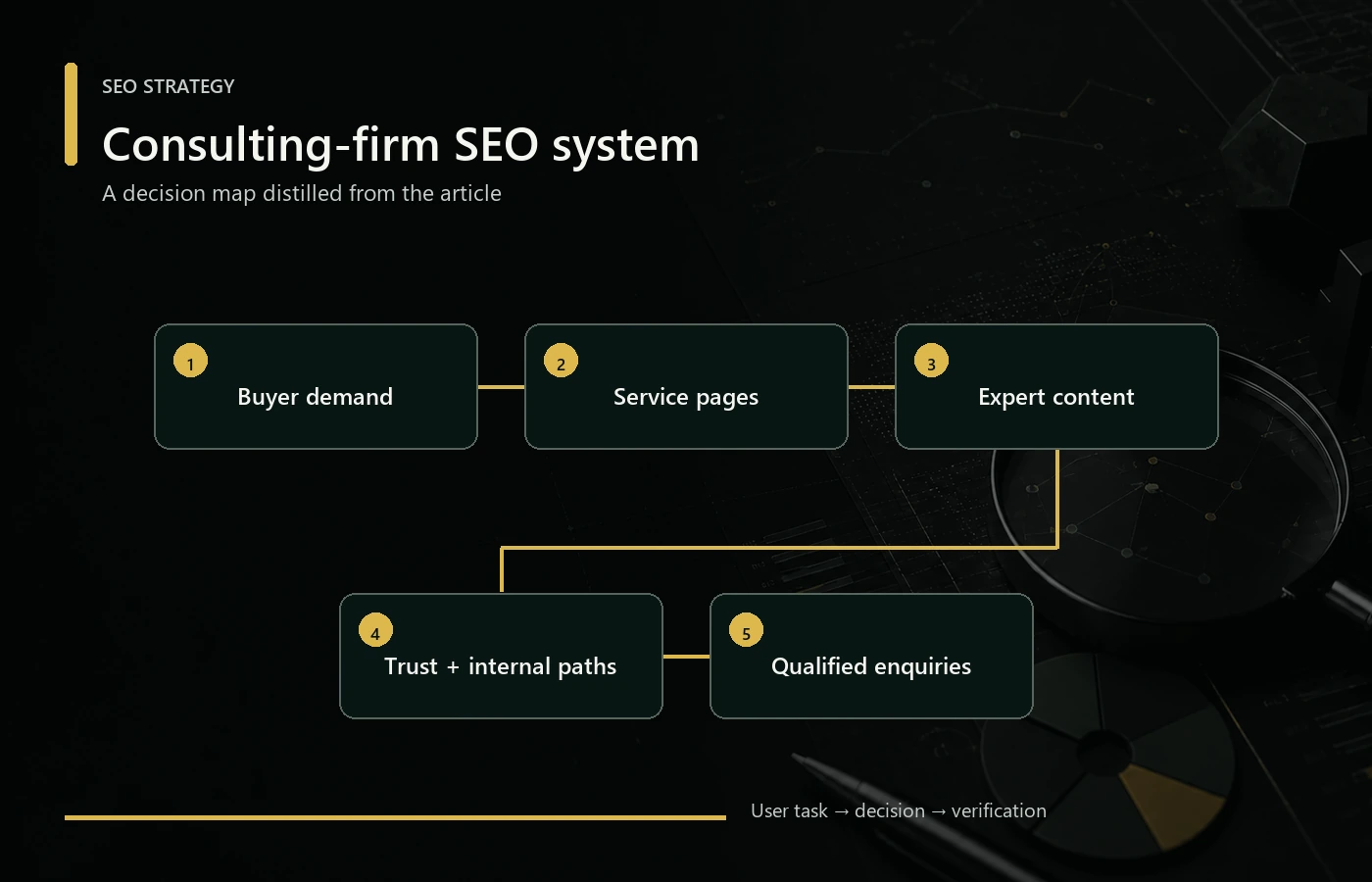
What a consulting-firm SEO system should look like
A mature structure is usually straightforward:
- Service pages own high-intent capability searches.
- Industry or solution pages exist only where sector or problem context changes the answer.
- Expert content addresses the research and evaluation questions buyers ask before contact.
- Author profiles, methods, and case studies make expertise verifiable.
- Internal links connect research pages to commercial destinations and deeper evidence.
- Local or international layers are added only where the operating footprint and market demand justify them.
- Measurement connects Search Console and analytics data to qualified-lead and CRM outcomes.
- Quarterly prioritization uses evidence from search, sales, and implementation rather than publishing quotas.
The result is not a site optimized for as many keywords as possible. It is a site that makes the firm's relevant expertise easy to discover, easy to evaluate, and easy to connect to a qualified business need.
How this page was prepared
Reviewed by SEO Strategy Editorial Team. Claims, terminology, and time-sensitive details were checked against the sources listed below and the page was last updated September 3, 2026.
AI-assisted tools supported research organization or drafting; editorial review remained responsible for source selection and the published conclusions.