

The previous version of this domain generated dozens of near-identical pages for London districts and postcodes. We did not restore them. A useful local SEO strategy should help people evaluate a real business in a real place, not swap a city name inside a template.
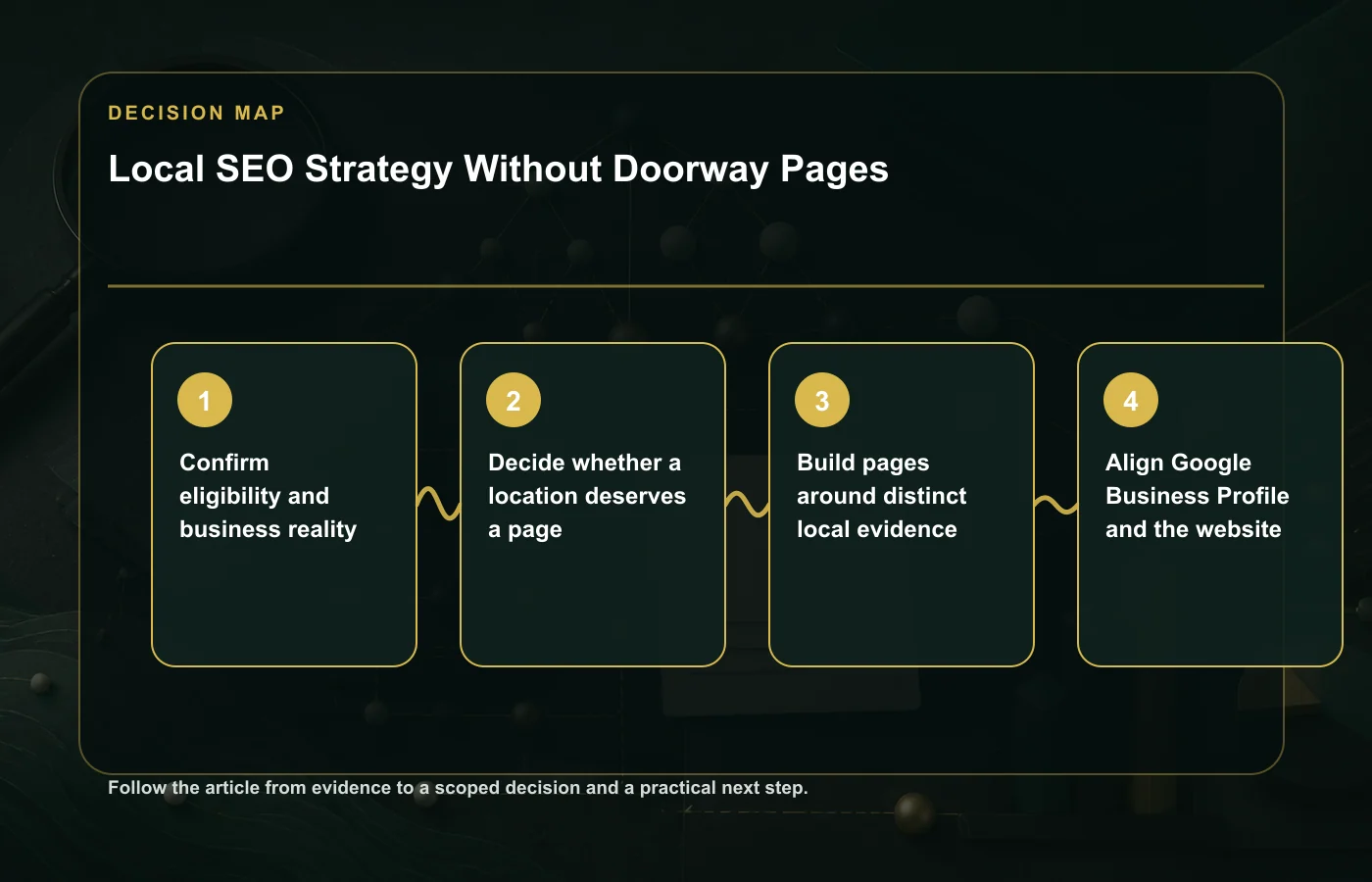
1. Confirm eligibility and business reality
Document the legal and customer-facing business name, real locations, service areas, phone numbers, opening hours, categories, and the pages representing each location. Google Business Profile has specific eligibility and representation requirements, including rules for storefronts, service-area businesses, virtual offices, and departments.
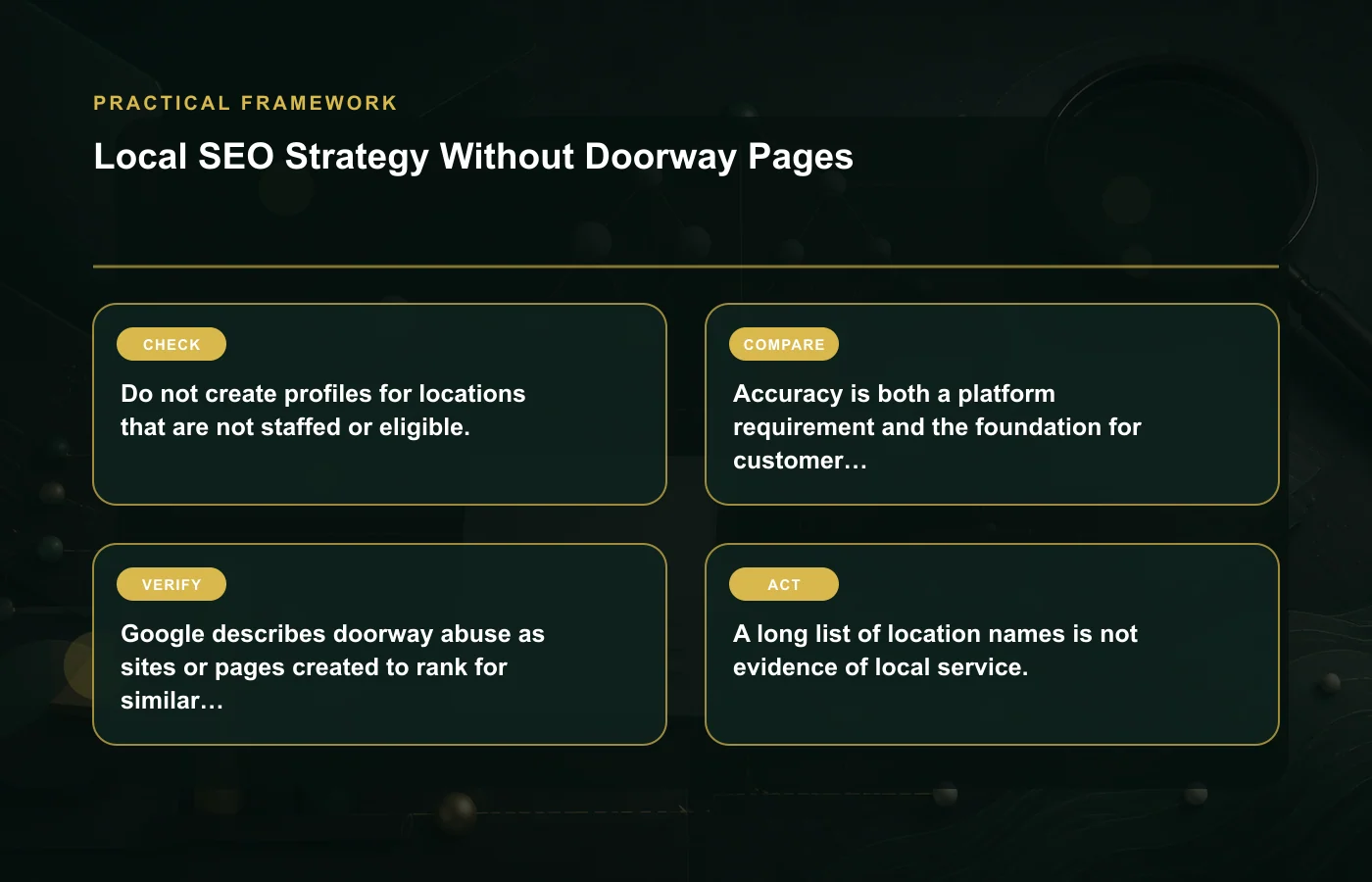
Do not add keywords to the business name unless they are part of the real-world name. Do not create profiles for locations that are not staffed or eligible. Accuracy is both a platform requirement and the foundation for customer trust.
2. Decide whether a location deserves a page
| Situation | Recommended destination |
|---|---|
| One real office serving a broad area | One strong location or service page with a truthful service-area explanation |
| Several staffed locations with distinct details | A location hub plus a useful page for each eligible location |
| Same service, no distinct local evidence | Keep the core service page; do not manufacture city pages |
| Old thin location URL with no equivalent | Return `404` or `410`; remove it from internal links and sitemaps |
| Old page has a true successor | Use a direct `301` to the page preserving its purpose |
Google describes doorway abuse as sites or pages created to rank for similar queries and funnel users to one less useful destination. A long list of location names is not evidence of local service.
3. Build pages around distinct local evidence
A legitimate location page should make a local decision easier. Include only information that is accurate and maintainable:
- Address or truthful service-area model, phone, hours, and accessibility details
- Services actually available at that location
- Original photos of the place, team, or work where appropriate
- Directions, parking, public transport, or service boundaries
- Local policies, availability, examples, and staff expertise
- Relevant reviews or case evidence with consent and clear provenance
If only the place name changes, the page probably does not need to exist.
4. Align Google Business Profile and the website
Choose the most specific accurate primary category, maintain regular and holiday hours, and link each profile to the page that best represents that location. Keep business information consistent enough that people can recognize the same entity, while respecting each platform's formatting.
Review the profile after moves, rebrands, phone changes, category changes, and seasonal schedule updates. Monitor suggested edits and duplicate profiles.
5. Build a responsible review process
Ask real customers for honest reviews without selecting only satisfied customers or offering prohibited incentives. Make the request part of a normal post-service workflow, provide a direct path, and respond professionally. Do not disclose private customer information in a response.
6. Earn local relevance beyond directories
Maintain accurate major citations, but prioritize relationships that real local audiences use: professional associations, suppliers, community organizations, local press, events, and relevant partners. The objective is not a maximum citation count. It is consistent discovery and credible local context.
7. Measure local outcomes
- Segment Search Console performance for location and service page groups.
- Track calls, direction requests, bookings, forms, and qualified store actions where privacy rules permit.
- Review profile completeness, duplicate issues, review velocity, and response operations.
- Compare local results from representative locations and devices without treating a single rank scan as ground truth.
- Annotate profile, website, and location changes.
Technical foundations still matter. Location pages must be crawlable, canonical, fast, mobile-friendly, and linked through a clear hierarchy. Use the technical audit checklist before scaling local content.
Primary references
- Google guidance on improving local ranking
- Google Business Profile representation guidelines
- Google spam policy on doorway abuse
How this page was prepared
Reviewed by SEO Strategy Editorial Team. Claims, terminology, and time-sensitive details were checked against the sources listed below and the page was last updated August 6, 2026.
AI-assisted tools supported research organization or drafting; editorial review remained responsible for source selection and the published conclusions.
Sources and verification
Primary and authoritative references used to verify this article: