

A keyword mapping template gives every search cluster one clear home: the page that can best satisfy its shared intent. Keyword mapping assigns groups of related searches — not single keywords — to the page type required to solve the problem, plus the evidence that makes the answer credible. Used well, this turns raw queries into a keyword to URL mapping your team can execute against, one cluster at a time.
This guide is also a keyword map template: the auditable columns in section six work as an SEO keyword mapping template you can copy directly, whatever the site — blogs, product catalogs, or comparison hubs.
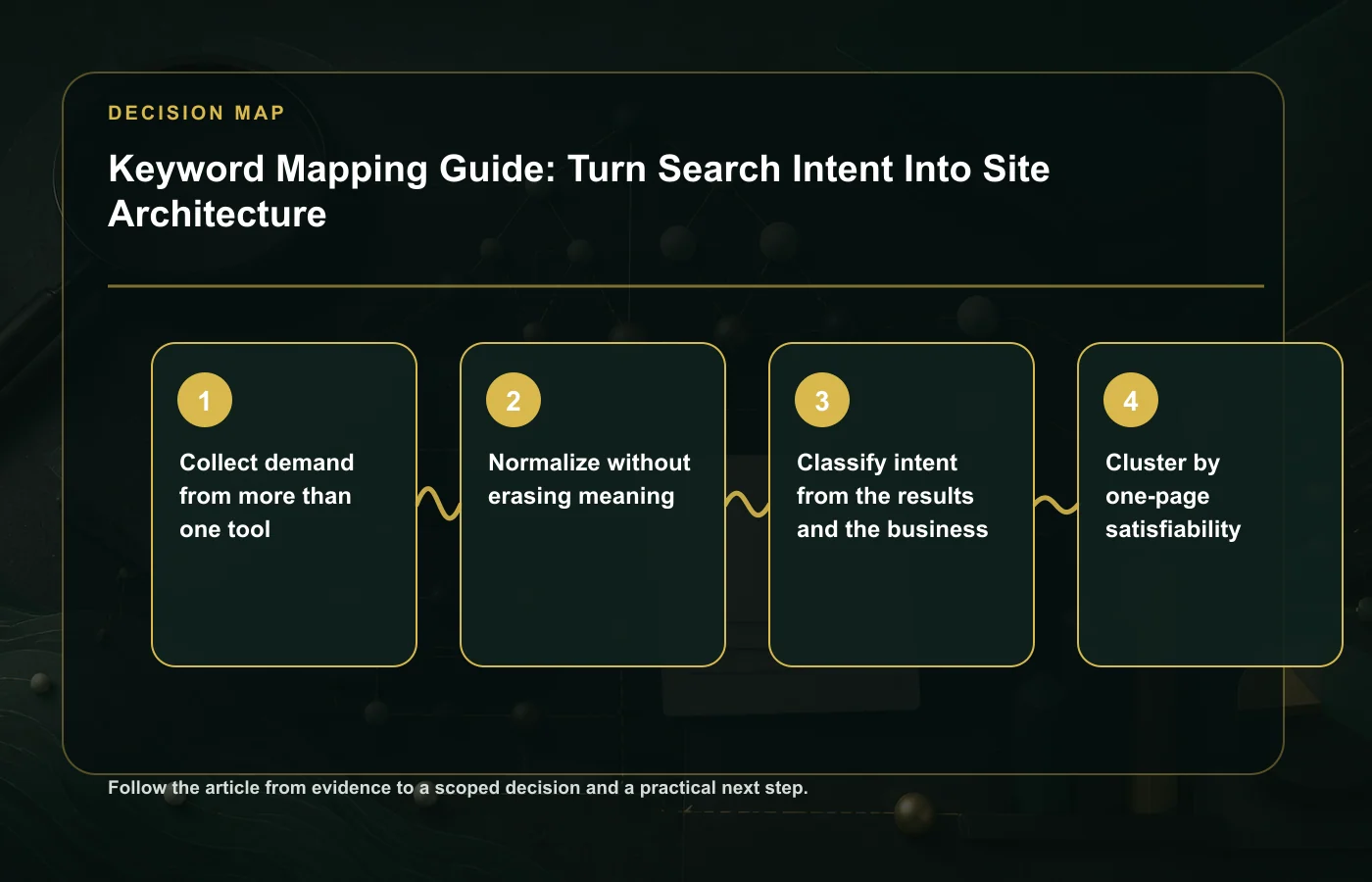
1. Collect demand from more than one tool
Start with first-party language: Search Console queries, sales questions, support tickets, internal site search, product terminology, and customer interviews. Add search-result observations, trend data, and third-party keyword estimates to discover adjacent phrasing and scale.
Keep source and date fields. Search volume, result composition, and business priorities change. A keyword row without provenance becomes difficult to review later.
2. Normalize without erasing meaning
Standardize casing, obvious spelling variants, and duplicated exports, but preserve modifiers that change the job: location, audience, price, comparison, problem, product type, and stage of awareness. "SEO audit," "SEO audit checklist," and "SEO audit service" share words but may require different pages.
3. Search intent mapping: classify intent from results and the business
This is search intent keyword mapping in practice: matching each cluster to the job it solves before you decide on a page type.
| Intent | Searcher needs | Likely page type |
|---|---|---|
| Learn | Understand a process, concept, or problem | Guide, explanation, checklist |
| Compare | Evaluate alternatives or tradeoffs | Comparison, category, review |
| Act | Buy, book, download, visit, or contact | Product, service, tool, location |
| Navigate | Reach a known brand, login, or resource | Brand or utility page |
Inspect the dominant result types, but do not copy the consensus blindly. Results reveal what Google currently finds useful; customer evidence reveals what competing pages may still omit.
4. Cluster by one-page satisfiability
Put two queries in one cluster when a strong page can answer both naturally without changing its primary purpose. Split them when the ideal page type, audience, evidence, location, or next action differs.
This test applies directly to keyword mapping for business categories and comparison pages: two comparison or category queries belong on the same page only if it can hold one title, one promise, and one set of proof points for both.
5. Keyword to URL mapping: assign clusters to existing or proposed URLs
Use one of five actions for every cluster:
- Keep: an existing page already matches the intent.
- Improve: the right URL exists but lacks depth, evidence, or clarity.
- Merge: several weak pages compete for one job.
- Create: meaningful demand has no suitable destination.
- Decline: the query is irrelevant, risky, or too thin for a distinct page.
This decision prevents a keyword export from becoming an automatic publishing queue.
6. Build the auditable map
| Column | Purpose |
|---|---|
| Cluster and intent | Defines the searcher problem |
| Primary and supporting queries | Preserves language and scope |
| Current URL and action | Prevents accidental duplication |
| Proposed title and page type | Clarifies the main promise |
| Evidence requirements | Lists data, examples, expertise, or documentation needed |
| Parent and child pages | Designs internal links before publication |
| Business value and confidence | Supports prioritization |
| Owner, status, and review date | Makes the map operational |
7. Detect cannibalization with evidence
Multiple ranking URLs do not automatically mean cannibalization. Investigate when pages repeatedly swap for the same query group, neither holds stable visibility, their purposes overlap, and internal signals cannot explain a useful distinction.
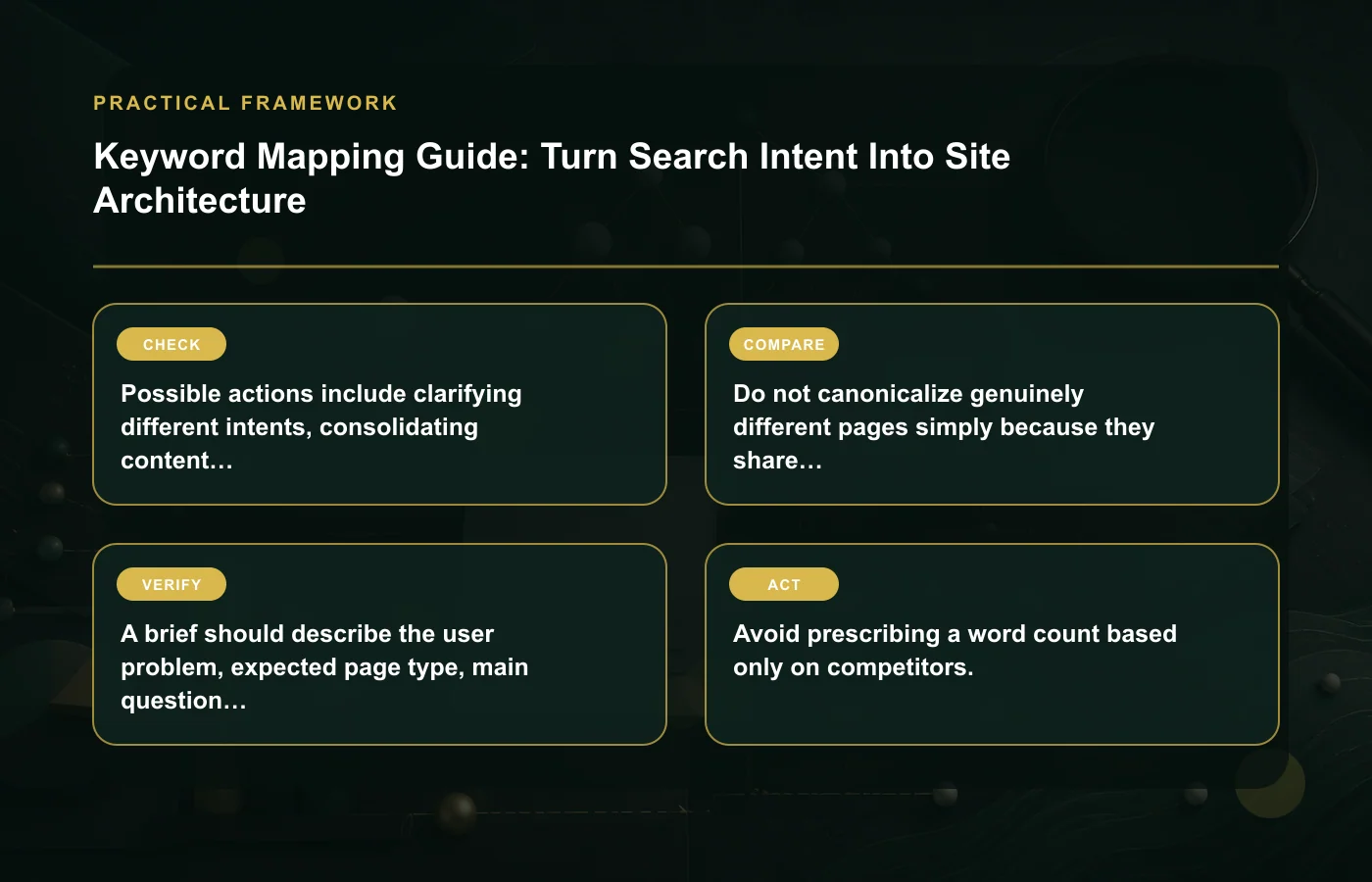
Possible actions include clarifying different intents, consolidating content into the strongest URL, updating internal links, or using a redirect when one page has a clear successor. Do not canonicalize genuinely different pages simply because they share several words.
8. Convert the map into content briefs
A brief should describe the user problem, expected page type, main question, supporting questions, evidence, unique contribution, internal links, and conversion role. Avoid prescribing a word count based only on competitors. The page is complete when it resolves the task with enough evidence and no deliberate padding.
Feed the resulting priorities into the 90-day SEO strategy, and revisit the map after major product changes or during a content decay audit.
FAQ
What is keyword mapping?
This guide walks through five decisions: collecting demand, normalizing it without losing meaning, classifying intent, clustering by one-page satisfiability, then mapping each cluster to a Keep, Improve, Merge, Create, or Decline decision for a specific URL. The result is a working map your team can execute against, not a list of keywords with no destination.
What is URL mapping in SEO?
URL mapping in SEO is section five of this process: matching every keyword cluster to an existing URL, an improved version of one, a merge target, a new page, or a decision to decline the query. It prevents a keyword export from becoming an automatic publishing queue, and it is the step that turns keyword-to-URL mapping into a plan a team can build against.
What does a keyword mapping example look like?
The column set in the keyword mapping template above is a ready example: cluster and intent, primary and supporting queries, current URL and action, proposed title and page type, evidence requirements, parent and child pages, business value and confidence, and owner, status, and review date. Fill one row per cluster and the map becomes an example other teams can reuse.
See the full process applied to a fictional dataset in the worked keyword mapping example, from raw queries through clustering, URL assignment, and cannibalization checks.
Primary references
How this page was prepared
Reviewed by SEO Strategy Editorial Team. Claims, terminology, and time-sensitive details were checked against the sources listed below and the page was last updated August 6, 2026.
AI-assisted tools supported research organization or drafting; editorial review remained responsible for source selection and the published conclusions.
Sources and verification
Primary and authoritative references used to verify this article:
Download "Keyword Mapping Template" and adapt it to your project.