

Editorial SEO is the operating process for turning search demand into accurate, useful, publishable content and then maintaining that content after launch. It sits between SEO research and editorial production: SEO identifies the search task, page role, evidence needs, internal relationships, and measurement plan; editorial work turns those inputs into a coherent page that meets the publication's standards. The process does not end when a draft is delivered. It includes expert review, fact-checking, on-page quality assurance, publication checks, performance analysis, and update decisions.
The practical objective is not to make every article “SEO-written.” It is to prevent two common failures: publishing useful editorial content that searchers cannot find or interpret easily, and producing search-targeted pages that satisfy a keyword brief but fail readers. A strong editorial SEO workflow gives each role clear inputs, decisions, acceptance criteria, and hand-offs.
What editorial SEO is — and what it is not
“Editorial SEO” is not a formal term defined by Google. In practice, it describes the workflow that connects search research to editorial planning, writing, review, publishing, measurement, and maintenance. That distinction matters because several adjacent disciplines overlap with it but solve different problems.
| Discipline | Primary question | Typical output | Where it stops |
|---|---|---|---|
| Editorial policy | What standards govern accuracy, sourcing, authorship, independence, corrections, and publication? | Rules and governance | It does not decide which search intents deserve pages or how those pages should be optimized. |
| Content SEO | What content should exist, which intent should each page own, and how should pages support organic discovery? | Content architecture, optimization, internal linking, prioritization | It may not define the day-to-day production and review system. |
| Publishing workflow | How does a draft move from assignment to publication? | Statuses, approvals, CMS steps, scheduling | It can function without search-demand research or post-publication SEO measurement. |
| Editorial SEO | How do we turn a validated search opportunity into a publishable page, then verify and maintain it? | Research-to-refresh operating workflow | It should defer to editorial policy on governance and to broader SEO strategy on portfolio-level priorities. |
A useful division of responsibility is simple: the editorial policy defines what the publication will and will not accept; the SEO content strategy defines what the content system should cover; editorial SEO defines how an approved page moves through production without losing either search intent or editorial quality.
Start with the search task, not the keyword
The first editorial SEO decision is whether a search opportunity deserves a page at all. A keyword list is evidence of language and demand, not a publication plan. Before assigning a topic, define the task a searcher is trying to complete and check whether an existing page already owns it.
For each candidate, answer five questions:
- What is the user trying to do? Learn a concept, compare options, complete a process, download an asset, select a provider, troubleshoot a problem, or make another decision.
- What page type best completes that task? A guide, service page, template, tool, comparison, glossary entry, category page, or update to an existing URL may be more appropriate than a new article.
- Does the site already have a page close enough to satisfy the intent? If yes, improve or reposition it before creating another URL.
- What evidence would make this page credible? Primary documentation, product data, internal expertise, examples, original analysis, or a clearly labelled working model.
- What would make the page unnecessary? Weak relevance to the audience, an existing URL with the same job, demand driven by a different format, or insufficient expertise to answer responsibly.
This is where Search Console can help without becoming the sole decision-maker. Its Performance report provides query and page dimensions, clicks, impressions, CTR, and average position; those signals can reveal real phrasing and existing URL ownership, but they are incomplete and should be interpreted alongside the content inventory and the actual search task. Google also recommends focusing on people-first content rather than writing to a target word count or producing pages mainly to attract search traffic.
For a deeper method on deciding whether a topic is genuinely missing, use the content gap analysis workflow.
Build an editorial calendar around decisions and dependencies
An editorial calendar is useful only after page roles and priorities are known. A calendar that starts with dates often creates artificial urgency: the team fills publishing slots because the slots exist. Editorial SEO works in the opposite direction. It sequences approved work according to business relevance, search opportunity, dependency, evidence availability, and production capacity.
A practical calendar should track more than a title and due date:
| Field | Why it matters |
|---|---|
| Page / cluster ID | Prevents title changes from breaking traceability. |
| Primary intent | Keeps the assigned page focused on one user task. |
| Existing or new URL | Forces an update-vs-create decision before drafting. |
| Parent / supporting pages | Shows architectural dependencies and planned internal links. |
| Evidence owner | Identifies who must provide or verify claims before publication. |
| Writer, reviewer, SEO QA | Makes hand-offs explicit. |
| Status and blocker | Separates genuine production progress from a calendar date. |
| Measurement note | Records what will be checked after publication and against which baseline. |
Do not force every item into a fixed publishing cadence. A high-value page waiting for a subject-matter review may be more important than three easy articles that can be shipped immediately. Likewise, parent pages, templates, or commercial destinations may need to exist before supporting articles can be linked correctly.
Turn approved topics into briefs that leave room for editorial judgment
A content brief should reduce ambiguity without becoming a competitor-outline replica. The writer needs to know the search task, page boundaries, evidence requirements, and acceptance criteria. The writer does not need instructions to repeat an exact-match keyword a specified number of times.
A useful editorial SEO brief contains:
- Primary search intent: the main task the page must complete.
- Primary query and supporting language: terms that clarify the topic, not a density target.
- Page type and URL role: new page, update, child page, commercial page, template, or another format.
- Reader context: what the intended audience likely knows before arriving and what decision they need to make next.
- Must-answer questions: the essential problems the page has to solve.
- Scope exclusions: nearby intents that belong to another URL.
- Evidence requirements: claims that need primary or authoritative sourcing, internal verification, or expert review.
- Internal links: destinations that genuinely help the reader continue the task.
- On-page requirements: title direction, H1 direction, metadata, tables or examples only where useful, and any preserved technical elements.
- Acceptance criteria: what must be true before the draft can move to publication.
The SEO content brief guide goes deeper into the hand-off itself. In an editorial SEO system, the brief is one control point inside a larger workflow rather than the final SEO deliverable.
Write for the decision the reader needs to make
The writing stage should convert the brief into the clearest possible answer. The most important editorial constraint is purpose: the opening should confirm that the reader has reached the right page, and each section should solve a distinct part of the task.
During drafting, use these rules:
- Answer the primary question early rather than spending several paragraphs establishing importance.
- Prefer specific processes, examples, decision rules, and limitations over generic advice.
- Use supporting queries to discover missing subtopics, not to dictate sentence wording.
- Distinguish observed facts from recommendations and professional judgment.
- Do not invent examples that look like client results. If an example is illustrative, label it as illustrative.
- Do not add a table, FAQ, or checklist because “SEO pages need them.” Add them when they reduce cognitive load or help a reader act.
- Do not write to a predetermined length. Stop when the intent is fully satisfied without repetition.
Use expert review where subject knowledge changes the answer
Not every page requires a named subject-matter expert, but some claims cannot be responsibly reviewed by an SEO editor alone. The editorial workflow should define when expert review is mandatory and what the reviewer is responsible for.
Expert review is especially useful when the page contains:
- technical implementation instructions where a small error can change the outcome;
- legal, financial, medical, security, or other consequential claims;
- product-specific functionality that may have changed;
- industry practices that vary materially by market or business model;
- original calculations, benchmarks, or methodology;
- recommendations that depend on operational constraints the writer cannot observe directly.
The reviewer should not be asked only, “Does this look good?” Give them a defined check: which claims need validation, which assumptions should be challenged, and which sections need a decision from someone with domain context.
Fact-check before polishing
Fact-checking should happen before the final copy-edit because factual corrections can change the structure of a section. Build a claim ledger for material statements rather than relying on the writer's browser history.
| Claim | Source / evidence | Status | Action |
|---|---|---|---|
| Platform or search-engine behavior | Current primary documentation | Verified / changed / unclear | Keep, update, qualify, or remove |
| Internal product capability | Product owner, documentation, live test | Verified / unverified | Publish only after verification |
| Industry recommendation | Reasoned editorial judgment plus supporting evidence where available | Context-dependent | State assumptions and limitations |
| Illustrative example | Created for explanation | Illustrative | Label clearly; do not imply observed results |
For search-specific claims, prefer current primary documentation. Google’s guidance on helpful content explicitly asks publishers to provide clear sourcing, demonstrate expertise where relevant, and avoid simply rewriting other sources. Those principles are useful editorial controls even when the target query is not about Google itself.
Run on-page QA as a separate pass
On-page QA should verify that the finished draft still satisfies the approved intent after writing and review. It is not a keyword-density check.
Intent and structure
- Does the first 100–150 words answer the core question or define the workflow?
- Does every H2 solve a distinct user need?
- Are any sections present only because competitors have them?
- Has a secondary intent grown large enough that it should belong to another URL?
- Are limitations and exceptions stated where recommendations can fail?
Search presentation
- Does the H1 accurately describe the page without exaggeration?
- Does the meta title differentiate the page from nearby URLs?
- Does the meta description explain the benefit of the page without promising rankings or results?
- Is the slug stable, readable, and aligned with the page's role?
Links and evidence
- Do internal links help the reader move to a related task rather than merely distributing anchor text?
- Are factual external links authoritative and current?
- Do anchors describe the destination?
- Were download links, tokens, embeds, or other functional elements preserved on updated pages?
Technical hand-off
- No duplicate H1 in the body HTML.
- Heading order is logical.
- Tables have clear header cells.
- Relative and absolute links are syntactically valid.
- Structured data is proposed only for content that exists on the page.
Publish with a baseline, not just a timestamp
Publication is the start of measurement, not the end of production. Record a before-state where one exists and an implementation note for the new page. For an update, capture the page's prior search performance and the date the substantive change went live. For a new page, record the publication date, intended query cluster, internal links added, and any dependencies still unresolved.
At minimum, monitor:
- indexation and canonical status for the published URL;
- queries and pages receiving impressions in Search Console;
- clicks and CTR where enough data exists to interpret them;
- organic landing-page engagement or conversion signals appropriate to the page type;
- internal-link coverage from the pages that were supposed to support the new URL;
- evidence of query drift or cannibalization with nearby pages.
Search Console’s Performance report is useful for seeing which queries and pages receive impressions and clicks. Treat average position as a directional metric rather than a business outcome, and avoid making decisions from a single low-volume query.
Update content when evidence changes the decision
A fixed “refresh every six months” rule is easy to administer but weak editorially. Review a page when there is a reason: a material fact changed, search intent shifted, the page lost useful coverage, a product or service changed, a new internal page now owns part of the topic, or performance data suggests the page is no longer matching the demand it was created for.
Choose the action based on diagnosis:
- Refresh: the page still owns the intent but facts, examples, sections, or evidence are stale.
- Expand: the intent is stable but an important decision or subproblem is missing.
- Reposition: the page is being shown for a different but coherent intent that is more valuable than the original target.
- Merge: two URLs perform the same job and one stronger page can satisfy the combined need.
- Redirect or retire: the page no longer has a useful independent role and another destination better serves users.
- Leave unchanged: weak short-term metrics alone are not evidence that a useful, accurate page needs rewriting.
The content decay audit provides a more detailed decision framework for refresh, merge, redirect, and removal.
Assign roles so SEO is not everyone's side task
Editorial SEO works best when responsibilities are explicit. One person can hold multiple roles in a small team, but the decisions should still be separated.
| Role | Accountable for | Should not be expected to decide alone |
|---|---|---|
| SEO strategist / researcher | Demand evidence, intent, page ownership, cannibalization risk, internal-link plan, measurement baseline | Editorial truth or expert claims outside their domain |
| Managing editor | Assignment quality, editorial standards, coherence, workflow status, final publication readiness | Search demand or technical SEO without evidence |
| Writer | Clear answer, original organization, accurate representation of sources, examples, draft completeness | Approving their own unsupported material claims |
| Subject-matter reviewer | Technical or domain accuracy in the areas assigned for review | Page-level SEO strategy unless that is also their role |
| Fact-checker / editor | Source verification, attribution, uncertainty, contradiction checks | Replacing expert judgment with copy-editing |
| SEO QA | Intent fit, metadata, headings, internal links, indexability hand-off, measurement notes | Changing approved factual conclusions to fit a keyword |
| Publisher / developer | CMS implementation, preserved functional elements, canonical/indexation controls, final rendering | Rewriting content without returning substantive changes to editorial review |
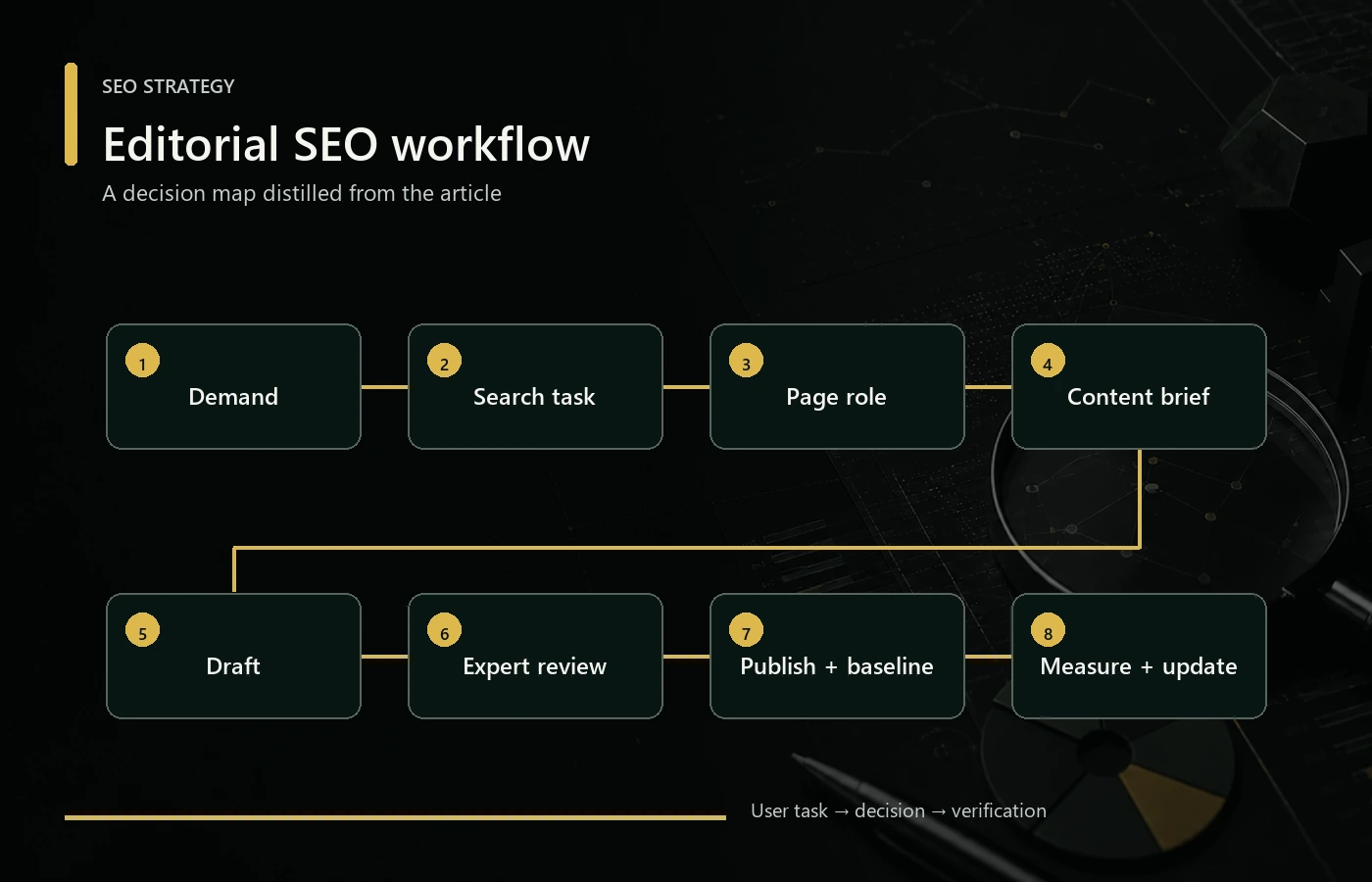
A practical editorial SEO workflow
- Capture the opportunity. Collect query data, site-search data, customer questions, sales/support inputs, competitor evidence, and editorial ideas.
- Map the inventory. Identify existing and planned URLs before approving anything new.
- Define intent and page role. Write one sentence describing the task the page must complete and one sentence describing what it will not cover.
- Approve priority. Score business relevance, evidence of demand, strategic fit, dependencies, and effort.
- Create the brief. Specify must-answer questions, evidence needs, internal relationships, and acceptance criteria.
- Draft. Answer the task directly, then build only the sections needed to complete it.
- Expert review and fact-check. Validate material claims before final polish.
- Editorial edit. Improve structure, clarity, consistency, and reader flow without reintroducing unsupported claims.
- Run SEO/on-page QA. Verify intent, metadata, headings, links, page differentiation, and technical hand-off.
- Publish and record the change. Preserve the release date, relevant baseline, and internal-link actions.
- Measure. Review query/page performance and business-appropriate engagement or conversion signals.
- Maintain. Refresh, expand, merge, reposition, or leave the page unchanged according to evidence.
Editorial SEO quality criteria
A page is ready for publication when the team can answer “yes” to the questions that matter for that page, not when every optional SEO field has been filled.
- Intent: Would a reader know within the opening whether the page solves their task?
- Completeness: Can the reader act without needing another generic article to fill an obvious gap?
- Accuracy: Are material factual claims verified, sourced, or explicitly qualified?
- Original value: Does the page organize, explain, compare, or demonstrate something rather than paraphrasing the current search results?
- Scope: Does the page avoid absorbing download, service, tool, or adjacent informational intents that belong elsewhere?
- Usability: Are tables, lists, examples, and headings used because they make the task easier?
- Search clarity: Do the title, H1, slug, and internal anchors make the page's role unambiguous?
- Evidence: Can a reviewer trace consequential claims to a reliable source or named internal verification?
- Maintenance: Is there a clear reason and method for revisiting the page when facts, intent, or performance change?
That is the core of editorial SEO: not a layer of keywords added after writing, but a controlled system that keeps search demand, reader value, editorial standards, and post-publication learning connected from the first opportunity to the next substantive update.
How this page was prepared
Reviewed by SEO Strategy Editorial Team. Claims, terminology, and time-sensitive details were checked against the sources listed below and the page was last updated September 3, 2026.
AI-assisted tools supported research organization or drafting; editorial review remained responsible for source selection and the published conclusions.