

For how to audit an xml sitemap, the useful starting point is a specific SEO decision: identify the affected page or query set, verify the current state, and change only what the evidence supports. In xml sitemap audit, begin with a sitemap should list the canonical urls you actually want discovered. Google says sitemap files should contain the canonical URLs you prefer to appear in Search, a current source-backed detail to keep separate from broader assumptions about xml sitemap audit and a sitemap should list the canonical urls you actually want discovered. For this xml sitemap audit analysis, Google documentation is the primary Google-specific reference; no ranking or indexing outcome is promised.
| Question | Evidence to capture | Decision unlocked |
|---|---|---|
| A sitemap should list the canonical URLs you actually want discovered | live HTML and crawl result | scope the issue |
| Check status codes, indexability, canonicals, and hostname consistency | Search Console or log evidence | choose the change |
| Treat lastmod as factual metadata, not a freshness decoration | URL cohort and implementation state | define verification |
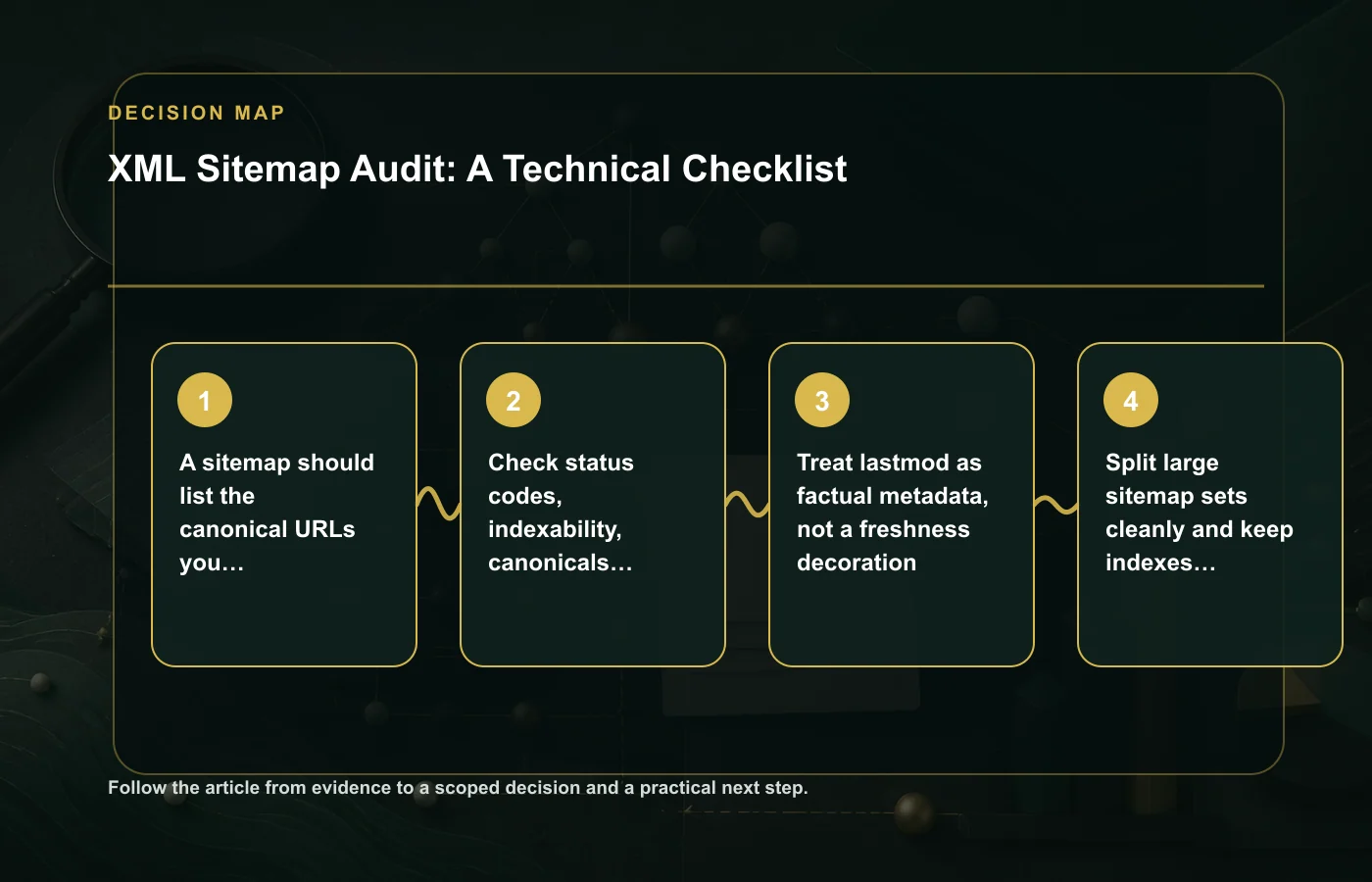
A sitemap should list the canonical URLs you actually want discovered
Google says sitemap files should contain the canonical URLs you prefer to appear in Search, a current source-backed detail to keep separate from broader assumptions about xml sitemap audit and a sitemap should list the canonical urls you actually want discovered. Within xml sitemap audit, test a sitemap should list the canonical urls you actually want discovered against a defined search task rather than treating how to audit an xml sitemap as a sitewide diagnosis. For the a sitemap should list the canonical urls you actually want discovered check in xml sitemap audit, pair the implementation note with the exact Google surface that supplied the signal, then note where how to audit an xml sitemap does and does not describe the same search problem. A contradictory page inside xml sitemap audit is useful for a sitemap should list the canonical urls you actually want discovered: it can show whether the issue belongs to a directory, a template, a query group, or only an isolated URL. That narrower reading of how to audit an xml sitemap in xml sitemap audit makes the proposed edit easier to reproduce, review, and reverse.
Document a sitemap should list the canonical urls you actually want discovered for xml sitemap audit before implementation: identify the affected set, capture the implementation note, name the owner, and record the condition that would falsify the recommendation. After the xml sitemap audit change, revisit the same search task; do not replace the acceptance test for a sitemap should list the canonical urls you actually want discovered with a different report simply because how to audit an xml sitemap looks better elsewhere. When a sitemap should list the canonical urls you actually want discovered in xml sitemap audit depends on Google-specific behavior, compare the live result with current Google guidance and separate a technical state change from later traffic or ranking movement. For how to audit an xml sitemap within xml sitemap audit, that distinction prevents correlation from being reported as proof of causation. Within xml sitemap audit, use faceted navigation seo crawl indexing and canonical best practices for the neighboring diagnostic or planning question instead of widening this article beyond its own search intent.
Check status codes, indexability, canonicals, and hostname consistency
A sitemap submission is a hint and does not guarantee that Google will crawl or index every included URL; for xml sitemap audit, that point is relevant specifically to check status codes, indexability, canonicals, and hostname consistency. Within xml sitemap audit, test check status codes, indexability, canonicals, and hostname consistency against a defined URL cohort rather than treating how to audit an xml sitemap as a sitewide diagnosis. For the check status codes, indexability, canonicals, and hostname consistency check in xml sitemap audit, pair the verification sample with the exact Google surface that supplied the signal, then note where how to audit an xml sitemap does and does not describe the same search problem. A contradictory page inside xml sitemap audit is useful for check status codes, indexability, canonicals, and hostname consistency: it can show whether the issue belongs to a directory, a template, a query group, or only an isolated URL. That narrower reading of how to audit an xml sitemap in xml sitemap audit makes the proposed edit easier to reproduce, review, and reverse.
Document check status codes, indexability, canonicals, and hostname consistency for xml sitemap audit before implementation: identify the affected set, capture the verification sample, name the owner, and record the condition that would falsify the recommendation. After the xml sitemap audit change, revisit the same URL cohort; do not replace the acceptance test for check status codes, indexability, canonicals, and hostname consistency with a different report simply because how to audit an xml sitemap looks better elsewhere. When check status codes, indexability, canonicals, and hostname consistency in xml sitemap audit depends on Google-specific behavior, compare the live result with current Google guidance and separate a technical state change from later traffic or ranking movement. For how to audit an xml sitemap within xml sitemap audit, that distinction prevents correlation from being reported as proof of causation.

Treat lastmod as factual metadata, not a freshness decoration
Sitemap lastmod should reflect meaningful page changes; inaccurate freshness signals make the file less useful for crawl scheduling, a current source-backed detail to keep separate from broader assumptions about xml sitemap audit and treat lastmod as factual metadata, not a freshness decoration. Within xml sitemap audit, test treat lastmod as factual metadata, not a freshness decoration against a defined query family rather than treating how to audit an xml sitemap as a sitewide diagnosis. For the treat lastmod as factual metadata, not a freshness decoration check in xml sitemap audit, pair the live-page check with the exact Google surface that supplied the signal, then note where how to audit an xml sitemap does and does not describe the same search problem. A contradictory page inside xml sitemap audit is useful for treat lastmod as factual metadata, not a freshness decoration: it can show whether the issue belongs to a directory, a template, a query group, or only an isolated URL. That narrower reading of how to audit an xml sitemap in xml sitemap audit makes the proposed edit easier to reproduce, review, and reverse.
Document treat lastmod as factual metadata, not a freshness decoration for xml sitemap audit before implementation: identify the affected set, capture the live-page check, name the owner, and record the condition that would falsify the recommendation. After the xml sitemap audit change, revisit the same query family; do not replace the acceptance test for treat lastmod as factual metadata, not a freshness decoration with a different report simply because how to audit an xml sitemap looks better elsewhere. When treat lastmod as factual metadata, not a freshness decoration in xml sitemap audit depends on Google-specific behavior, compare the live result with current Google guidance and separate a technical state change from later traffic or ranking movement. For how to audit an xml sitemap within xml sitemap audit, that distinction prevents correlation from being reported as proof of causation. For xml sitemap audit, the adjacent SEO dependency is covered in orphan pages in seo how to find evaluate and fix; follow that path only when the present xml sitemap audit diagnosis exposes that separate issue.
Split large sitemap sets cleanly and keep indexes discoverable
Google says sitemap files should contain the canonical URLs you prefer to appear in Search; here, the narrow implication for xml sitemap audit is the issue described by split large sitemap sets cleanly and keep indexes discoverable. Within xml sitemap audit, test split large sitemap sets cleanly and keep indexes discoverable against a defined template group rather than treating how to audit an xml sitemap as a sitewide diagnosis. For the split large sitemap sets cleanly and keep indexes discoverable check in xml sitemap audit, pair the source record with the exact Google surface that supplied the signal, then note where how to audit an xml sitemap does and does not describe the same search problem. A contradictory page inside xml sitemap audit is useful for split large sitemap sets cleanly and keep indexes discoverable: it can show whether the issue belongs to a directory, a template, a query group, or only an isolated URL. That narrower reading of how to audit an xml sitemap in xml sitemap audit makes the proposed edit easier to reproduce, review, and reverse.
Document split large sitemap sets cleanly and keep indexes discoverable for xml sitemap audit before implementation: identify the affected set, capture the source record, name the owner, and record the condition that would falsify the recommendation. After the xml sitemap audit change, revisit the same template group; do not replace the acceptance test for split large sitemap sets cleanly and keep indexes discoverable with a different report simply because how to audit an xml sitemap looks better elsewhere. When split large sitemap sets cleanly and keep indexes discoverable in xml sitemap audit depends on Google-specific behavior, compare the live result with current Google guidance and separate a technical state change from later traffic or ranking movement. For how to audit an xml sitemap within xml sitemap audit, that distinction prevents correlation from being reported as proof of causation. A separate internal route from xml sitemap audit is crawled or discovered currently not indexed a diagnostic guide; it is relevant when the evidence here points to that distinct crawl, content, linking, or measurement task.
Keep redirected, duplicate, parameter, and noindex URLs out of the preferred set
A sitemap submission is a hint and does not guarantee that Google will crawl or index every included URL, which matters in this xml sitemap audit discussion when considering keep redirected, duplicate, parameter, and noindex urls out of the preferred set. Within xml sitemap audit, test keep redirected, duplicate, parameter, and noindex urls out of the preferred set against a defined page segment rather than treating how to audit an xml sitemap as a sitewide diagnosis. For the keep redirected, duplicate, parameter, and noindex urls out of the preferred set check in xml sitemap audit, pair the before-state with the exact Google surface that supplied the signal, then note where how to audit an xml sitemap does and does not describe the same search problem. A contradictory page inside xml sitemap audit is useful for keep redirected, duplicate, parameter, and noindex urls out of the preferred set: it can show whether the issue belongs to a directory, a template, a query group, or only an isolated URL. That narrower reading of how to audit an xml sitemap in xml sitemap audit makes the proposed edit easier to reproduce, review, and reverse.
Document keep redirected, duplicate, parameter, and noindex urls out of the preferred set for xml sitemap audit before implementation: identify the affected set, capture the before-state, name the owner, and record the condition that would falsify the recommendation. After the xml sitemap audit change, revisit the same page segment; do not replace the acceptance test for keep redirected, duplicate, parameter, and noindex urls out of the preferred set with a different report simply because how to audit an xml sitemap looks better elsewhere. When keep redirected, duplicate, parameter, and noindex urls out of the preferred set in xml sitemap audit depends on Google-specific behavior, compare the live result with current Google guidance and separate a technical state change from later traffic or ranking movement. For how to audit an xml sitemap within xml sitemap audit, that distinction prevents correlation from being reported as proof of causation.
Compare sitemap URLs with crawl and internal-link inventories
Sitemap lastmod should reflect meaningful page changes; inaccurate freshness signals make the file less useful for crawl scheduling; here, the narrow implication for xml sitemap audit is the issue described by compare sitemap urls with crawl and internal-link inventories. Within xml sitemap audit, test compare sitemap urls with crawl and internal-link inventories against a defined search task rather than treating how to audit an xml sitemap as a sitewide diagnosis. For the compare sitemap urls with crawl and internal-link inventories check in xml sitemap audit, pair the implementation note with the exact Google surface that supplied the signal, then note where how to audit an xml sitemap does and does not describe the same search problem. A contradictory page inside xml sitemap audit is useful for compare sitemap urls with crawl and internal-link inventories: it can show whether the issue belongs to a directory, a template, a query group, or only an isolated URL. That narrower reading of how to audit an xml sitemap in xml sitemap audit makes the proposed edit easier to reproduce, review, and reverse.
Document compare sitemap urls with crawl and internal-link inventories for xml sitemap audit before implementation: identify the affected set, capture the implementation note, name the owner, and record the condition that would falsify the recommendation. After the xml sitemap audit change, revisit the same search task; do not replace the acceptance test for compare sitemap urls with crawl and internal-link inventories with a different report simply because how to audit an xml sitemap looks better elsewhere. When compare sitemap urls with crawl and internal-link inventories in xml sitemap audit depends on Google-specific behavior, compare the live result with current Google guidance and separate a technical state change from later traffic or ranking movement. For how to audit an xml sitemap within xml sitemap audit, that distinction prevents correlation from being reported as proof of causation.
How this page was prepared
Reviewed by SEO Strategy Editorial Team. Claims, terminology, and time-sensitive details were checked against the sources listed below and the page was last updated September 23, 2026.
AI-assisted tools supported research organization or drafting; editorial review remained responsible for source selection and the published conclusions.
Sources and verification
Primary and authoritative references used to verify this article: