

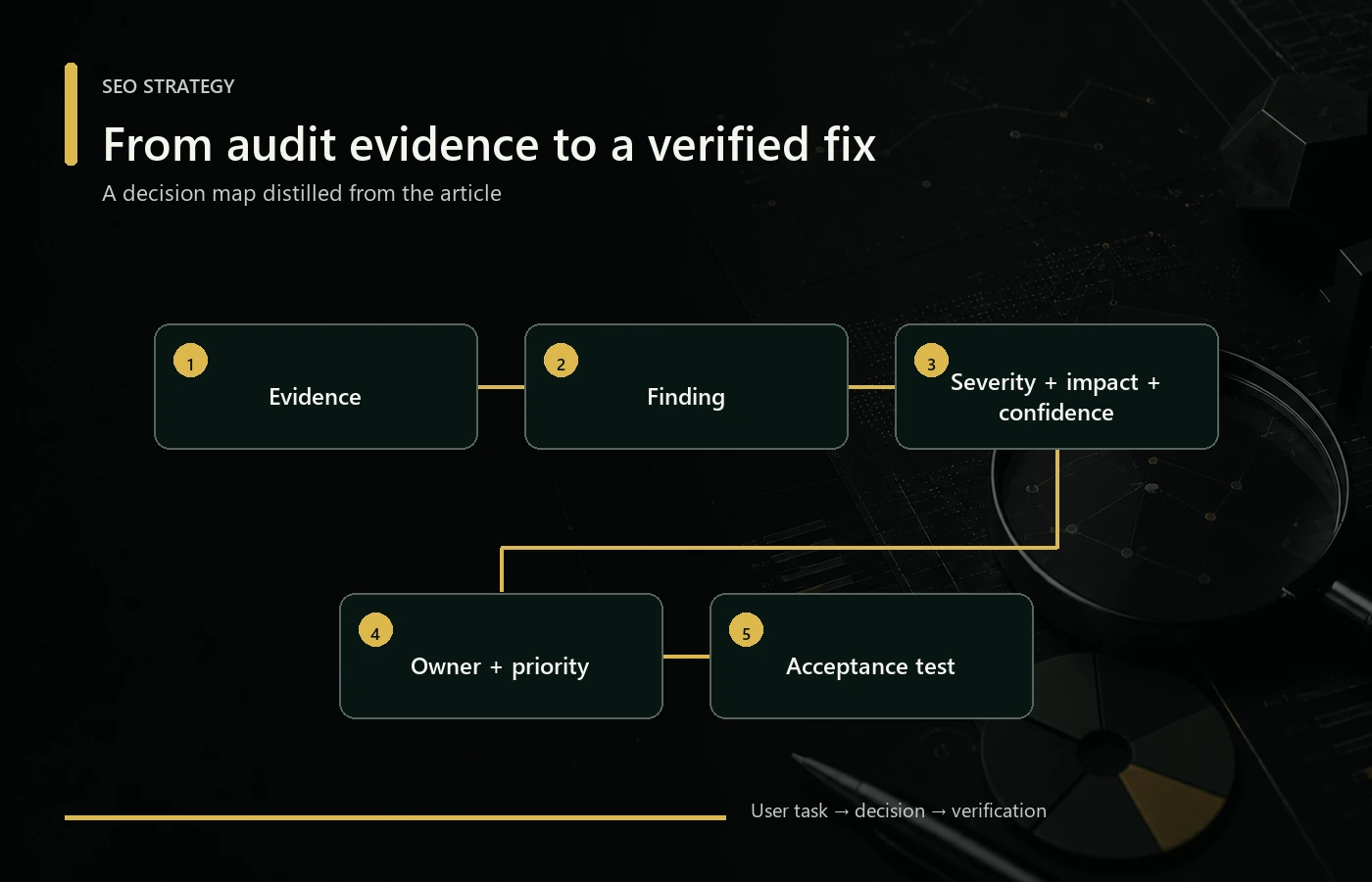
An SEO audit report should turn observed evidence into decisions a team can implement and verify. A useful report does not simply list crawl-tool warnings. For each material finding, it explains what was observed, which page group or business function is affected, how severe the issue appears, how confident the auditor is in the diagnosis, what should change, who needs to own the work, and how the team will confirm the fix after release.
This SEO audit report example uses a fictional site and illustrative data to show how those parts fit together. The example is deliberately small enough to read, but the structure scales to larger technical, content, architecture, and mixed SEO audits. If you need an editable document rather than a worked explanation, use the Technical SEO Audit Report template; this article focuses on how to reason through and present the findings.
The example scenario
Assume an ecommerce site has recently redesigned its category templates. Organic performance has weakened on several high-value categories, the crawl inventory is larger than expected, and stakeholders have received multiple tool exports but no agreed action plan.
The audit scope is limited to four questions:
- Can Google discover and index the intended category and product pages?
- Are canonical and internal-link signals consistent?
- Did the redesign create template-level problems affecting important page groups?
- What should the team fix first, and how will each fix be validated?
This is not a real client case and the numbers below are illustrative. The point is the report structure, not the values.
1. Executive summary: lead with the decisions
The executive summary should not repeat every issue. It should explain the few conditions that materially affect the site and what leadership needs to approve or resource.
Illustrative executive summary
- Primary constraint: the redesigned category template outputs canonical tags pointing to the first paginated URL for some category states. The pattern affects a high-value page group and should be corrected before broad metadata work.
- Secondary constraint: important subcategories are reachable only through faceted navigation and are absent from the main crawlable category path, weakening discovery and internal prominence.
- Index hygiene issue: parameter combinations are internally linked at scale even though most are not intended to be independent search landing pages. This expands crawl activity and complicates reporting.
- Lower-priority issue: several category title tags are duplicated. This should be corrected after the template-level canonical and architecture problems because it does not explain the main indexation inconsistency.
Recommended sequence: fix the canonical template, restore stable internal paths to priority subcategories, reduce unnecessary parameter links, then clean up metadata on the remaining affected templates. Validate each change on a defined sample before rolling the same fix across the full site.
2. Evidence: show what was observed
Evidence should be reproducible. A screenshot can help, but it is rarely enough on its own. A good finding identifies the source, sample, date or state where relevant, and the expected behavior being tested.
| Evidence type | Example | Why it matters |
|---|---|---|
| HTML / response | Canonical tag from sampled category pages | Shows the live template output rather than a crawler interpretation alone |
| Internal crawl | Count and path depth for priority subcategories | Shows how the site's own links expose the page group |
| XML sitemap | Presence or absence of intended canonical URLs | Provides another discovery and preferred-URL signal to compare |
| Search Console | URL Inspection, Page indexing, and Performance report samples | Shows what Google reports about selected URLs and how pages appear in Search |
| Analytics / business data | Landing-page conversions or revenue role | Helps distinguish technically interesting issues from commercially important ones |
| CMS / template rule | Actual canonical or navigation logic | Identifies whether the issue is systemic and where it should be fixed |
Google’s URL Inspection tool can show information about Google’s indexed version of a URL and can test whether a live URL may be indexable. The Page indexing report provides site-level indexing information, but “not indexed” does not automatically mean “error”; the reason and the intended role of the URL need to be interpreted. Those distinctions are why an audit report should connect tool output to expected behavior rather than treating every flagged URL as a defect.
3. Separate severity, impact, and confidence
Weak reports often collapse several ideas into one “priority” label. Separating severity, impact, and confidence makes the recommendation easier to challenge and revise.
Severity
Severity describes how serious the observed condition is if the diagnosis is correct.
- Critical: blocks or materially disrupts a core search function for an important page group.
- High: creates a substantial limitation or conflicting signal affecting important pages.
- Medium: degrades quality or efficiency but is not the main constraint.
- Low: localized cleanup, minor inconsistency, or issue with limited expected effect.
Impact
Impact describes the affected scope and business relevance. A technically severe issue on five obsolete URLs can have lower business impact than a moderate issue on the main service template.
Record:
- affected templates or page groups;
- approximate scale if it can be measured reliably;
- search demand or current visibility tied to the group;
- conversion, revenue, lead, or strategic role where available;
- dependencies on launches, migrations, or other teams.
Confidence
Confidence describes how strongly the available evidence supports the diagnosis and proposed remedy.
- High confidence: the issue is reproducible, the mechanism is understood, and contradictory samples have been checked.
- Medium confidence: evidence is consistent but a dependency or causal step remains unverified.
- Low confidence: the finding is a hypothesis that needs another test before implementation.
Confidence is especially important when traffic changes are involved. A decline can coincide with a technical issue without proving that the issue caused the decline. The report should state that difference.
4. Worked findings table
The table below shows how the fictional audit could be summarized. The evidence and scale are illustrative.
| ID | Finding | Evidence | Severity | Impact | Confidence | Recommendation | Owner | Validation |
|---|---|---|---|---|---|---|---|---|
| TECH-01 | Category canonical rule points selected states to an unintended paginated URL | Live HTML on 12 sampled categories; crawler confirms template pattern; URL Inspection shows mixed canonical outcomes on sampled URLs | High | Priority category template | High | Correct the canonical rule so intended category URLs self-canonicalize unless a documented exception applies | Engineering | Retest source HTML and URL Inspection samples after release; monitor affected page group |
| ARCH-02 | Priority subcategories lack stable crawlable links from parent navigation | Crawl paths require filter interactions; sitemap contains URLs but parent categories do not expose them consistently | High | High-value subcategory group | High | Add persistent HTML links from relevant parent/category modules and verify page-role hierarchy | UX + Engineering | Recrawl from homepage and parent categories; confirm target subcategories are reachable through intended paths |
| CRAWL-03 | Faceted parameter combinations receive large volumes of internal links | Crawl shows many parameter URLs generated from repeated filter links; most are not intended landing pages | Medium | Sitewide crawl efficiency and reporting clarity | Medium | Define which facet states deserve crawlable links and remove or change unnecessary link generation without blocking required user functionality | SEO + Engineering | Compare post-release crawl inventory and sampled paths; ensure intended facets remain discoverable |
| ONP-04 | Duplicate category title patterns | Metadata export shows repeated generic titles on a subset of categories | Low | Selected category pages | High | Generate distinct titles from category-specific attributes after higher-priority template fixes | SEO + Content | Re-export titles; spot-check rendered results and page differentiation |
Notice what the table does not contain: a generic “why this matters for SEO” paragraph repeated for every row. Each finding is tied to the affected page group, evidence, implementation owner, and acceptance test.
5. Write recommendations as implementation decisions
A recommendation should tell the team what behavior needs to change, not merely restate the symptom.
| Weak recommendation | Better recommendation |
|---|---|
| “Fix canonical tags.” | “Update the category template so intended category URLs output a self-referencing canonical unless a documented alternate canonical rule applies; test the rule on paginated and faceted states before rollout.” |
| “Improve internal linking.” | “Add persistent crawlable links from each parent category to the approved priority subcategories and confirm that those URLs are reachable without filter-state interaction.” |
| “Reduce crawl waste.” | “Define the subset of facet states that need independent crawlable URLs, then stop generating standard internal links to the remaining parameter combinations while preserving user filtering.” |
The better version includes the intended behavior and enough context to write a ticket. It still avoids dictating code when the report has not validated the implementation environment.
6. Prioritize by constraint, dependency, and reach
Priority should answer “what should happen first?” rather than “which issue sounds most serious?” A practical sequence uses four dimensions:
- Constraint: does this issue prevent useful pages from being discovered, indexed, understood, or used as intended?
- Reach: does the issue affect one URL, one template, or a large business-critical page group?
- Dependency: must this be fixed before another task can be evaluated properly?
- Effort and risk: what implementation cost, regression risk, or cross-team dependency is involved?
For the example, the canonical template comes before title cleanup because it affects how the category page group is represented and evaluated. Architecture comes before writing more category copy because a page that is poorly integrated into the site remains structurally weak regardless of copy depth.
The parent Technical SEO Audit Checklist explains the broader diagnostic order: define scope, test discovery and indexation, reconcile URL signals, review architecture, measure experience, and turn the evidence into a report.
The Technical SEO Audit service group is the separate commercial destination for teams looking for audit execution rather than an example report structure.
7. Convert priorities into a roadmap
The report should include a roadmap only at the level supported by the evidence. Do not invent precise delivery dates when engineering capacity is unknown. Use sequencing and dependencies first.
| Phase | Work | Dependency | Exit condition |
|---|---|---|---|
| Phase 1: Stabilize signals | TECH-01 canonical template correction | Engineering access and test environment | Approved sample outputs correct canonicals in live HTML |
| Phase 2: Restore architecture | ARCH-02 internal paths to priority subcategories | Navigation/module decision | Approved subcategories are reachable through persistent links |
| Phase 3: Control crawl paths | CRAWL-03 facet-link rules | Facet inventory and UX requirements | Unneeded parameter links reduced without breaking required filters |
| Phase 4: Clean remaining on-page issues | ONP-04 title patterns and lower-priority metadata | Stable category template | Distinct metadata rule applied and spot-checked |
This roadmap is stronger than “Week 1–2 / Week 3–4” because it can survive changes in team capacity. Codex, a project manager, or the implementation team can add dates after owners confirm effort.
8. Assign ownership at the point of recommendation
An audit without ownership becomes a reference document rather than an implementation system. Each material item should have one accountable owner or owning team and any supporting roles.
- SEO: expected search behavior, scope, acceptance criteria, prioritization.
- Engineering: template logic, server responses, rendering, deployment.
- UX / Product: navigation and filtering behavior where user experience is affected.
- Content: copy, metadata, taxonomy language, content consolidation.
- Analytics: measurement changes where the issue affects reporting or conversion tracking.
Ownership should be realistic. “SEO + Dev” is not enough when nobody is accountable for making the decision or scheduling the work.
9. Define validation before implementation
The acceptance test belongs in the original finding. If validation is added later, teams often substitute an easy metric for the actual expected behavior.
For each issue, define:
- the exact page or template sample to retest;
- the observable technical state that should change;
- the contradictory cases that must remain correct;
- the production data source to monitor after release;
- the period or condition required before evaluating downstream search performance.
For example, a canonical fix is first validated in the HTML and with Google’s inspection data where available. A later change in clicks or rankings is a downstream outcome, not the acceptance test for whether the tag was implemented correctly.
10. Keep implementation validation separate from performance impact
Every important fix has at least two questions:
- Was the change implemented correctly?
- Did the affected search or business outcome change afterward?
The first can often be answered quickly with a crawl, live HTML, rendered output, or Search Console inspection. The second may require more time and can be influenced by many factors. Reports become misleading when they treat later ranking movement as proof that the implementation was correct, or treat no immediate ranking movement as proof that the fix failed.
What weak SEO audit reports get wrong
They export tool warnings without interpretation
A crawler label is a clue. The report still needs to determine whether the behavior is intended, which page group is affected, and whether the issue matters.
They use severity without business context
“Critical” is not useful if the issue affects a page type the business does not need indexed. Scope and page role are part of impact.
They imply causation from correlation
A traffic decline and a technical defect can occur at the same time. The report should state what is observed, what is inferred, and what remains unproven.
They provide generic recommendations
“Improve content,” “fix internal links,” or “optimize Core Web Vitals” are themes, not implementation-ready findings.
They omit confidence
Teams need to know whether a recommendation is a verified defect or a hypothesis worth testing.
They do not assign owners or dependencies
A 100-row issue list without ownership is difficult to sequence and easy to ignore.
They stop at delivery
An audit is incomplete if the team cannot tell whether a fix was implemented correctly. Retesting should be part of the report design.
A reusable SEO audit finding structure
For each finding, use this sequence:
- Observation: what was found.
- Expected behavior: what the page or system should do.
- Evidence: where the finding was verified.
- Scope: which URLs, templates, or systems are affected.
- Severity and impact: how serious the condition is and why this affected group matters.
- Confidence: how certain the diagnosis is.
- Recommendation: what behavior should change.
- Owner and dependency: who acts and what must happen first.
- Acceptance test: how implementation will be verified.
- Post-release monitoring: which search or business signals should be watched afterward.
That structure turns an SEO audit report from a static diagnosis into an implementation record. Use the worked example to understand the reasoning; use the editable audit report template when you need a document to fill in and hand off.
How this page was prepared
Reviewed by SEO Strategy Editorial Team. Claims, terminology, and time-sensitive details were checked against the sources listed below and the page was last updated September 3, 2026.
AI-assisted tools supported research organization or drafting; editorial review remained responsible for source selection and the published conclusions.
Download "SEO Audit Report Template for Technical SEO Audits" and adapt it to your project.