
A link building strategy should explain why another publisher would cite a specific page and why that citation helps its audience. Raw backlink volume is not a business outcome, and automated links from irrelevant pages can obscure useful evidence rather than create authority.
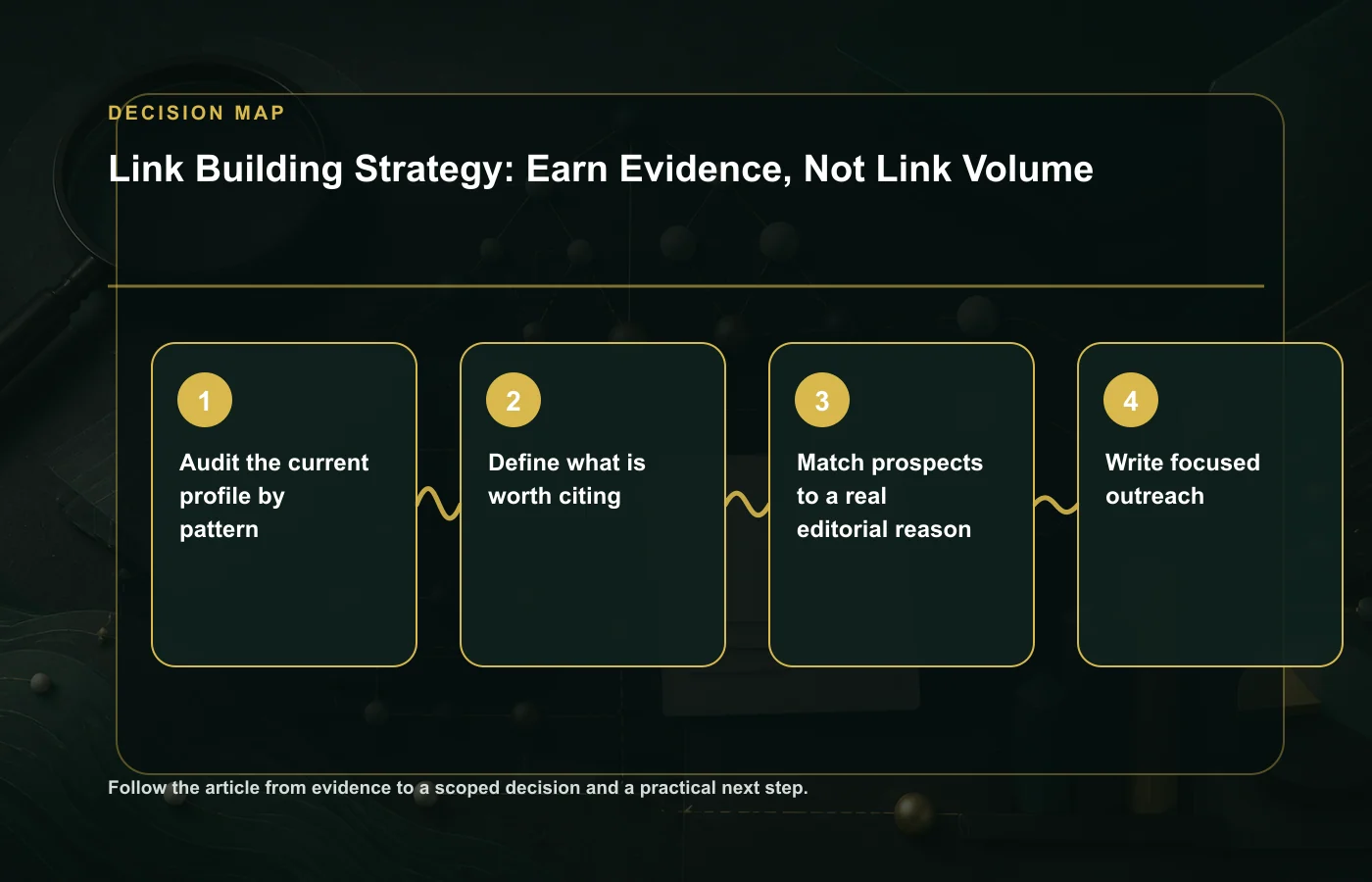
1. Audit the current profile by pattern
Group links by source type, relevance, target page, anchor pattern, discovery date, and likely editorial process. Look for concentrations that require investigation: sitewide links, generated pages, unrelated languages or topics, repeated exact-match anchors, and bursts from domains sharing the same template.
Do not assume every unfamiliar or low-metric link needs action. Search engines can ignore many links. Focus on manual actions, clear manipulation you control, security incidents, and patterns that distort decision-making.
2. Define what is worth citing
| Asset | Reason to cite | Maintenance requirement |
|---|---|---|
| Original dataset or benchmark | Provides evidence unavailable elsewhere | Methodology, sample, limitations, update date |
| Decision framework or template | Makes a difficult task easier | Clear instructions and revision history |
| Expert explanation | Clarifies a complex or changing issue | Named experience and primary references |
| Tool or calculator | Produces a useful result | Transparent assumptions and functional upkeep |
| Case study | Shows a reproducible process and outcome | Context, baseline, intervention, caveats |
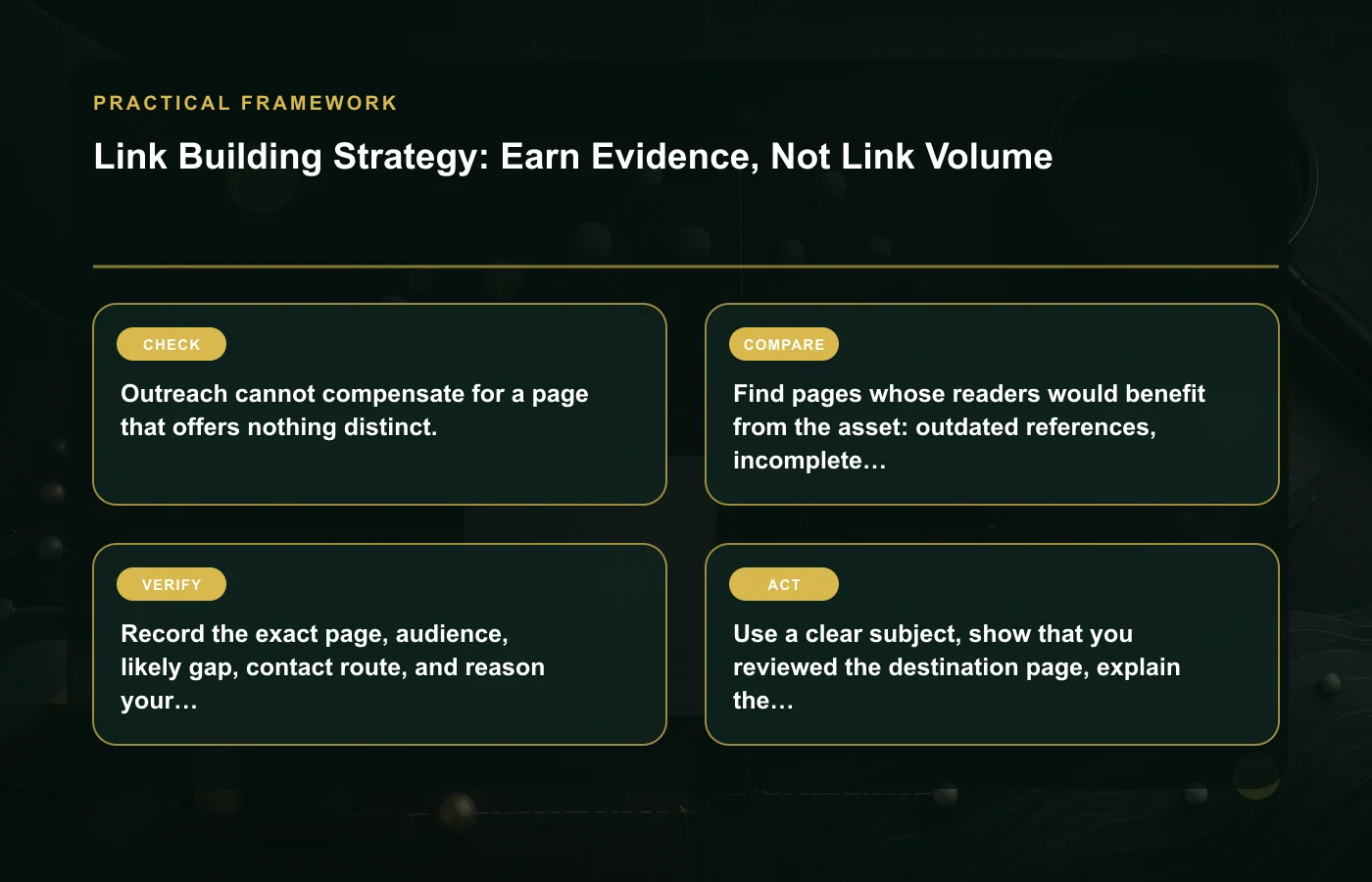
Build the asset before creating a large prospect list. Outreach cannot compensate for a page that offers nothing distinct.
3. Match prospects to a real editorial reason
Find pages whose readers would benefit from the asset: outdated references, incomplete resource lists, articles citing weaker data, relevant newsletters, professional organizations, or journalists covering the topic. Record the exact page, audience, likely gap, contact route, and reason your source improves the existing material.
4. Write focused outreach
Use a clear subject, show that you reviewed the destination page, explain the specific value for its readers, and provide the relevant source. Avoid manufactured urgency, false familiarity, and claims about guaranteed ranking impact. One thoughtful follow-up is usually enough unless the recipient invites further contact.
5. Use promotion channels that fit the asset
- Expert contributions supported by first-hand knowledge
- Digital PR based on timely, defensible data
- Partnerships with organizations serving the same audience
- Resource-page outreach where the source fills a documented gap
- Community participation where sharing the asset answers an existing question
- Owned newsletters and social distribution that reach potential citers
6. Avoid link-spam patterns
Google's spam policies include buying or selling links for ranking purposes, excessive reciprocal exchanges, automated link creation, low-quality directory links, optimized links in distributed content, and advertorial links that pass ranking credit. Paid and user-generated links should use appropriate link attributes.
Avoid evaluating vendors only by promised domain metrics or link counts. Review the real site, audience, editorial standards, traffic relevance, page context, disclosure, and whether the publisher independently chooses what to cite.
7. Measure quality and outcomes
| Level | Metric |
|---|---|
| Production | Useful assets published and kept current |
| Relationship | Qualified conversations and repeat editorial contacts |
| Placement | Relevant followed or attributed citations on useful pages |
| Audience | Qualified referral visits, subscriptions, leads, or assisted conversions |
| Search | Target-page discovery and performance reviewed alongside other changes |
| Risk | Suspicious patterns, removals, policy issues, and vendor quality |
Links are one part of the wider SEO strategy. Technical access, search intent, content quality, brand demand, and product experience can change at the same time, so do not claim causation from a link count alone.
Use the contextual backlink quality guide to evaluate whether an in-content placement is relevant, editorially justified, transparent, and useful beyond a link metric.
Primary references
- Google spam policy on link spam
- Google guidance for helpful, reliable content
- Google Search Console Performance report
How this page was prepared
Reviewed by SEO Strategy Editorial Team. Claims, terminology, and time-sensitive details were checked against the sources listed below and the page was last updated August 6, 2026.
AI-assisted tools supported research organization or drafting; editorial review remained responsible for source selection and the published conclusions.
Sources and verification
Primary and authoritative references used to verify this article:
Download "Link Building Template" and adapt it to your project.